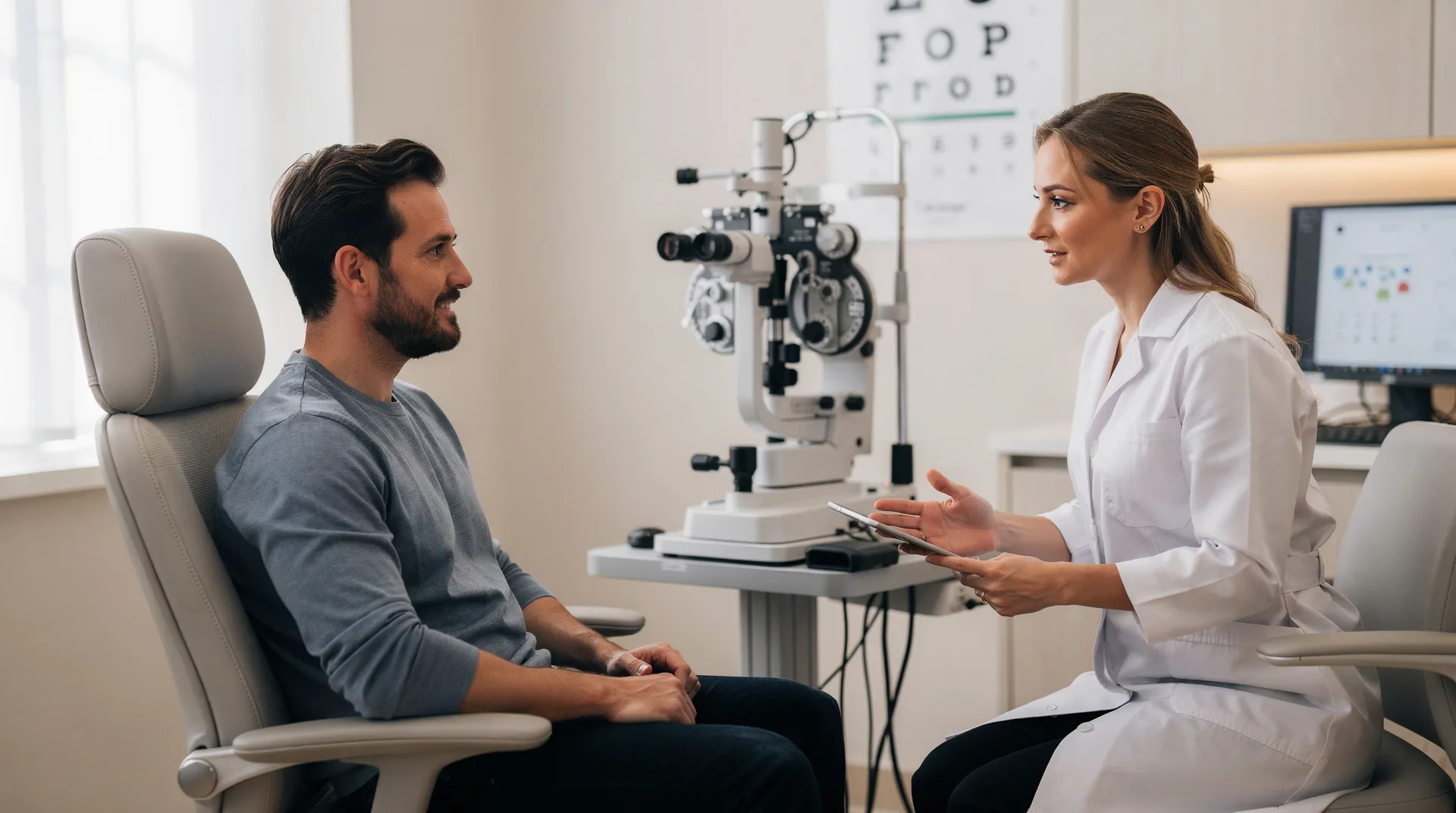
Turn the search for a LASIK provider into an evidence audit
The best place for LASIK is not a universal title that a clinic can claim. It is the practice whose evaluation, procedure recommendations, cost explanation, and follow-up plan make sense for your eyes and priorities. Compare those parts directly instead of treating a ranking, a low quote, or polished marketing as proof that the practice fits you.
More than 95% of participants in the FDA LASIK Quality of Life study reported satisfaction with their vision following LASIK surgery. That figure measures reported satisfaction among study participants; it does not establish that every person will have the same result or that satisfaction replaces an examination and individualized discussion.
The practice comparison can begin with four questions:
- Evaluation: Does the visit examine vision stability, eye health, corneal structure, and factors that could affect healing or suitability?
- Selection: Does the clinician explain why LASIK fits your findings, or why PRK, an implantable lens, glasses, or contacts may be more relevant?
- Counseling: Are visual symptoms, residual need for correction, recovery, and follow-up discussed in the same conversation as the hoped-for benefit?
- Total care: Can you understand what the quoted price includes and how the practice will guide you after surgery?
A practice earns your serious consideration by answering these questions clearly and specifically.
A useful audit separates promises from details you can evaluate. Record what each practice examined, what procedure it discussed, which alternatives it considered, what limitations it explained, and what the written estimate includes. Then compare the records using the same questions. This approach keeps the decision tied to your care pathway instead of to a slogan or a national label.
Clarify what LASIK is meant to change
LASIK is a type of refractive surgery that uses a laser to treat refractive errors usually corrected with glasses or contact lenses. In an outpatient procedure, the laser changes the shape of the cornea so light rays are focused more effectively on the retina. LASIK is used to treat nearsightedness, farsightedness, and astigmatism, and it can reduce or eliminate your need for corrective eyewear.
The treatment goal gives you a useful starting point for comparing practices: ask what visual problem the proposed treatment is intended to change, what level of dependence on glasses or contacts is realistic for you, and which parts of your daily vision matter most. Distance driving, computer work, reading, sports, and night vision may shape the questions you bring to the evaluation, but your eye examination must determine which procedure is appropriate.
The FDA study also shows why a practice should discuss function and symptoms, not only an eye-chart target. Less than 1 percent of study participants had a lot of difficulty with, or could not do, usual activities without corrective lenses because of any one visual symptom after LASIK surgery. In the same study, up to 46 percent of participants without visual symptoms before LASIK reported at least one visual symptom three months after surgery, and up to 40 percent of participants who had no halos before LASIK had halos three months after surgery. These figures measure different outcomes, so ask how the practice will discuss both visual performance and possible symptoms.
Your daily vision priorities should appear in the consultation, not only in your private expectations. Tell the clinician whether you rely on night driving, spend long periods at a screen, read frequently, play contact sports, or want to reduce dependence on lenses for a particular activity. These details do not determine eligibility, but they help you ask whether the proposed plan addresses the vision you actually use.

Audit the evaluation before judging the practice
A meaningful LASIK evaluation tests whether your vision has changed, checks your refractive error and other eye problems, and measures and maps the thickness and surface of your cornea. Choosing among laser-vision-correction options also requires attention to corneal thickness, corneal curvature, and corneal topography. Corneal topography maps the corneal surface and may help determine whether LASIK or a surface-ablation technique is appropriate for you.
The health and history review should address factors that can change the decision:
- Has your prescription changed within the past year? A prescription change within that period is called refractive instability, and you should discuss possible additional risks with your doctor.
- Does the evaluation check for severe dry eye, keratoconus, cataract, and other eye diseases that could affect laser vision correction?
- Could an autoimmune disease, an immunodeficiency state, diabetes, or a medication affect healing after refractive surgery?
- Do contact sports involving regular blows to the face or eyes affect whether LASIK is appropriate for you?
These are discussion points, not a self-clearance test. Ask the clinician to connect each answer to your examination and options.
No lasers are currently approved for LASIK on people under age 18. If you are an adult, age alone still does not establish candidacy; the practice must interpret your prescription, corneal measurements, eye health, medical history, and healing considerations together.
Your evaluation record should make the decision understandable after the appointment. Write down whether the practice explained your prescription stability, corneal measurements, eye-health findings, and any condition or medication that could affect healing. If the explanation stops at a general statement that you are or are not a candidate, ask which examination finding led to that conclusion and what alternatives remain relevant.

Compare the options the examination makes relevant
Your examination should explain the procedure choice rather than leave you comparing procedure names in isolation.
| Option | What changes | What to ask about fit |
|---|---|---|
| LASIK | A laser reshapes the cornea, and the procedure creates a corneal flap. | Ask how your corneal measurements, prescription, and eye health support or limit this option. |
| PRK or another surface-ablation procedure | PRK removes the outer corneal layer instead of creating a flap; surface-ablation techniques avoid creating a corneal flap. | PRK may suit people with thinner corneas, but ask about the longer and more uncomfortable healing pattern. |
| Implantable lens | Phakic lens implantation is a surgical alternative to LASIK. | We offer ICLs for people with irregular corneas, dry eyes, or prescriptions that exceed the acceptable range for LASIK or PRK; ask whether your findings make that discussion relevant. |
PRK usually requires 3-5 days for the epithelium to heal. Recovery can be more uncomfortable, and vision may be blurry for a few days to weeks. Those differences do not make PRK a universal substitute for LASIK; they give you specific questions about healing, work, driving, activities, and follow-up.
Other alternatives can include refractive lens exchange, lenticule extraction surgery, phakic lens implantation, glasses, and contact lenses. We offer LASIK, PRK, refractive lens exchange, and phakic IOL options for the surgical treatment of high myopia. If LASIK is not suitable for you, we offer other laser eye surgery options. Ask any practice to explain why its proposed path matches your findings rather than assuming that having more than one procedure available makes one option right for you.
The safety and effectiveness of the described LASIK treatment are unknown for eyes that changed by more than 0.5 diopter in nearsightedness or astigmatism during the last 12 months while the condition is still changing. Tell the clinician about prescription changes and ask how stability affects the decision before scheduling surgery.
The option discussion should answer three separate questions: what the procedure does, why it may fit your findings, and what trade-offs it creates for recovery or daily vision. Ask the clinician to compare the proposed procedure with the alternatives that remain medically relevant to you. A clear explanation can include a reason not to proceed with LASIK or a reason to continue using glasses or contacts.
Test whether safety and outcomes are discussed in balance
A balanced discussion includes the possibility of visual symptoms as well as the hoped-for reduction in corrective-lens dependence. In the FDA LASIK Quality of Life study, up to 46 percent of participants with no visual symptoms before surgery reported at least one visual symptom at three months after surgery. Up to 40 percent of participants with no halos before LASIK had halos three months after surgery. Up to 28 percent of participants with no dry-eye symptoms before LASIK reported dry-eye symptoms three months after surgery. LASIK can also have side effects such as dry eyes, halos, double vision, regression, or changes in vision.
More than 95% of participants in the FDA study reported satisfaction with their vision following LASIK surgery. Satisfaction and symptoms are separate measures: you can ask how the practice defines a satisfactory result, how it discusses night vision and dry eye, and what support is available if your experience differs from your expectations.
Participants in the FDA study were more than twice as likely to report visual symptoms on a questionnaire than to tell their health care provider. Make symptom reporting part of your comparison. Ask how you should describe glare, halos, double vision, dry-eye symptoms, or changes in night driving, and who should receive that information during follow-up. Dry-eye risk varies from person to person and should be discussed after an eye examination. Glare and halos can occur after laser vision correction, while appropriate evaluation and technology may make them less likely than with older devices and smaller treatment zones.
The counseling quality matters because a favorable satisfaction figure does not answer every question about visual comfort or daily function. Ask whether the consent discussion covers residual need for glasses or contacts, the possibility of symptoms, how concerns should be reported, and what follow-up is available. Compare the specificity of the answers, not the confidence of the presentation.
Use the consultation to verify the care process
A LASIK consultation becomes more useful when you take a written question list. Ask:
- What did the vision, eye-health, corneal-thickness, curvature, and topography measurements show?
- How do those measurements affect the proposed procedure and treatment plan?
- Which alternatives were considered, and what finding makes each one more or less relevant?
- Which surgeon would perform the procedure, what relevant qualifications and LASIK or refractive-surgery experience does that surgeon have, and how can I verify those details?
- What visual changes, dry-eye symptoms, night-vision concerns, and need for glasses or contacts should you plan for?
- What will the informed-consent form say, and can the doctor answer every question before surgery?
A clear answer should connect the proposed care to your examination rather than relying on a generic description.
Your surgeon uses corneal measurements to program the computer-based laser used during surgery. Ask which technology is proposed and why it suits your measurements. Femtosecond-assisted LASIK provides slightly better flap-thickness predictability than microkeratome-assisted LASIK and may make LASIK suitable for some borderline candidates, but that possibility does not determine your candidacy. Ask the clinician to explain the specific finding that supports the recommendation.
The practical plan should be clear before you commit:
- Have a thorough examination and arrange not to drive or work after it, as the FDA checklist recommends.
- Read and understand the informed-consent form, and ask your doctor to answer your questions before surgery.
- Avoid makeup for 24-36 hours before surgery, as the FDA checklist recommends.
- Arrange for someone to drive you home after surgery.
- Plan to take a few days to recover, because vision may not be clear immediately.
- Be prepared to use drops or medications at regular intervals and wear an eye shield for a period after surgery to help avoid injury.
The practice should be able to explain how these instructions fit your scheduled care.
Your consultation notes can use five headings: findings, recommended procedure, alternatives, practical requirements, and follow-up. Under each heading, write the answer in the practice’s own terms and add the question that remains unresolved. This creates a side-by-side record for comparing practices and helps you notice whether an important topic was skipped.
Compare written prices as complete care plans
LASIK cost varies by provider and commonly depends on the vision correction required, the technology used, and the surgeon’s experience. Geographic location and local cost of living can affect cost, and many variations can exist between providers within the same state. Your prescription may mean you pay more or less than someone else, and LASIK may cost more for people with extremely poor vision.
A written estimate should name its pricing unit and separate included care from possible additional charges. Use this checklist:
- Does the estimate cover one eye or both eyes?
- Is the examination or repeat testing included?
- Which technology and procedure does the estimate describe?
- Are facility charges, surgeon fees, medications, protective supplies, and follow-up visits included?
- What circumstances could change the estimate after the examination?
- What is the practice’s written policy for further correction or enhancement?
- Which financing terms, if any, apply, and what amount would you actually repay?
- Does any insurance or benefit plan apply, or is the procedure treated as an out-of-pocket service?
Ask for each answer in writing so you can compare like with like.
Custom LASIK often costs more than older technology, and manufacturers’ additional charges may be passed on to you. More experienced surgeons tend to charge a little more, and location can change the total. Extremely low-cost LASIK may involve hidden fees, a less experienced surgeon, or undesired or unapproved technology. The practical boundary is simple: do not choose a quote until you understand what it buys, what it excludes, and which examination findings could change it.
The price comparison should use the same unit for every practice. Record whether each figure applies per eye or to both eyes, whether the figure is conditional on a prescription or procedure, and which services are included. Keep financing separate from the procedure price so a monthly payment does not obscure the total amount, fees, or repayment conditions. If a practice cannot explain what changes the estimate, mark that question for follow-up before making a decision.
Compare recovery support before scheduling
Immediately after LASIK, your eye may burn, itch, feel as though something is in it, tear, or have mild pain. Your vision will probably be hazy or blurry, and light sensitivity, glare, starbursts, halos, or redness may occur. During the first 24 hours, your eyes may feel tender or sore even if your vision has already improved, and tenderness, soreness, or temporary blur may affect your plans. These symptoms should improve considerably within the first few days, so plan to take a few days off work until they subside.
A recovery timeline should make the practical demands concrete:
- Surgery day: protect your eyes, reduce visual demands, and follow the instructions given for the first evening.
- First 24 hours: plan around possible tenderness, soreness, or temporary blur.
- First week and month: track activity restrictions and visual changes while your eyes adjust.
- Three to six months: understand that stabilization can continue after you feel ready to resume much of your routine.
Your vision may take up to three to six months to stabilize after surgery, and glare, halos, difficulty driving at night, and other visual symptoms may persist during that period.
Follow-up after laser surgery will probably include regular visits with your eye doctor for six months or longer. Follow your surgeon’s directions for prescribed drops, medications, and any protective eye shield, especially at night. If further correction is needed, the selected FDA guidance says to wait until eye measurements are consistent for two consecutive visits at least 3 months apart before re-operation, as directed by your doctor. Ask before scheduling how follow-up visits, changing symptoms, and any further treatment will be handled.
Only a certain percentage of patients achieve 20/20 vision without glasses or contacts. You may need additional treatment, although it may not be possible, and you may still need glasses or contact lenses after surgery. A practice that explains this possibility gives you a more useful recovery plan than a promise of a particular endpoint.
The recovery conversation should also cover who gives you instructions, how you report a change, and when the scheduled plan is not enough. Ask which activities need restrictions, how medication and protective measures will be explained, and how follow-up is arranged if your symptoms do not follow the expected course. Compare the clarity of that pathway before you schedule.
Consider DLV Vision as one local comparison option
DLV Vision is one local option to assess against the same questions if you are comparing practices in Los Angeles or Ventura County. We prioritize determining whether you are eligible for LASIK based on your medical history, current prescription, and other health and eye-related factors. We offer free consultations to determine whether you are a candidate for LASIK or other corrective eye surgeries.
DLV Vision offers other laser eye surgery options if LASIK is not suitable for you, as well as consultations for laser eye surgery options. Use the appointment to ask what your examination showed, why a particular procedure is being considered, which alternatives remain relevant, what recovery requires, and how the total price is defined. Those questions let you compare our care pathway with any other practice using the same standards.
A DLV Vision consultation is a starting point, not a promise that LASIK will be suitable or that a particular result will follow. Proceed only after a qualified clinician has evaluated your eyes, explained the available choices and limitations, and answered your questions about care after surgery.
Prepare correctly and know when symptoms need prompt help
Your preparation should begin with instructions that protect the quality of your evaluation. Contact lenses can change your corneal shape for up to several weeks after you stop wearing them, depending on the lens type. Wearing them too close to evaluation can lead to inaccurate measurements and a poor surgical plan. The FDA checklist also says to avoid contact lenses before evaluation and surgery. Ask the practice how long you should stop wearing your particular lenses rather than choosing a duration yourself.
Your preparation sequence can include these steps:
- Bring your current prescription, relevant eye-care history, medication information, and questions to the examination.
- Arrange not to drive or work after the examination if the practice recommends it.
- Arrange transportation home after surgery.
- Follow the treating surgeon’s directions for drops, medications, and any protective eye shield.
- Do not rub your eye after surgery because rubbing could dislodge the flap and require further treatment.
- Track activity restrictions and visual changes during the first week and month while your eyes adjust.
Postoperative symptoms need immediate contact with your doctor rather than a wait for the scheduled visit if you have severe pain or if your vision or other symptoms worsen instead of improve. Do not wait for a routine follow-up when a change is getting worse. If you are unsure whether a symptom is urgent, contact a qualified eye-care professional promptly.
Arrange the consultation that can answer the audit
Your choice should rest on specific answers about your examination, procedure alternatives, visual expectations, recovery, follow-up, and complete cost. Bring your prescription and eye-care history, ask for the care plan in writing, and compare the answers with your priorities rather than comparing slogans. A qualified professional must decide your individual suitability after examining your eyes.
A consultation request is appropriate when you are ready to discuss candidacy, alternatives, costs, recovery, and follow-up with a qualified provider. For adults comparing practices in the United States, including people in Ventura and Los Angeles County, bring the questions from this guide and proceed only when the evaluation and care plan fit your eyes and priorities.
What should I ask before choosing a LASIK practice?
What should a written LASIK quote include before I compare it with another practice?
Confirm whether the amount is for one eye or both, which examination and testing are included, and whether technology, facility charges, medications, follow-up, and possible enhancements are covered. Ask what findings could change the estimate, and keep financing terms separate from the total procedure price. LASIK costs vary with the prescription, technology, surgeon experience, provider, and location, so a national price alone would not determine whether a quote is appropriate.
How long should I stop wearing contact lenses before a LASIK evaluation?
Contact lenses can change corneal shape for up to several weeks after you stop wearing them, depending on the lens type. Wearing them too close to an evaluation can affect measurements and the surgical plan. Ask the evaluating practice how long to stop wearing your specific lenses rather than choosing a duration yourself.
When should I contact an eye doctor after LASIK instead of waiting for a follow-up visit?
Contact your doctor immediately if you have severe pain or if your vision or other symptoms worsen instead of improve. Do not rub the eye after surgery, because rubbing could dislodge the corneal flap and require further treatment. If you are unsure whether a change is urgent, contact a qualified eye-care professional promptly.
When might PRK or an implantable lens be discussed instead of LASIK?
PRK removes the outer corneal layer instead of creating a flap and may suit some people with thinner corneas, but healing usually takes 3-5 days for the epithelium and can involve more discomfort and temporary blur. An implantable lens may be discussed for some people with irregular corneas, dry eyes, or prescriptions outside the acceptable range for LASIK or PRK. An eye examination must determine which options are relevant to you.