Start with the decision LASIK is meant to support
Refractive surgery may be considered when you want to rely less on glasses or contact lenses. Refractive surgery may be considered for occupational or cosmetic reasons as well as for everyday convenience, but wanting less dependence does not by itself establish whether the procedure fits your eyes. The useful decision is whether your examination, vision needs, expectations, and available alternatives point toward LASIK or another option.
A sound evaluation follows a sequence rather than a promise:
- Establish whether your prescription and eye health fall within the factors considered for LASIK.
- Understand what the procedure changes and what it cannot correct, including the possibility of needing glasses later.
- Compare LASIK with PRK or an implantable lens when corneal structure, dry eye, prescription strength, or lifestyle makes another path worth discussing.
- Plan for early symptoms, transportation, follow-up, and the longer period in which vision may stabilize.
- Ask specific questions about the surgeon, technology, alternatives, total cost, financing, and care after the procedure.
This approach gives you a practical next step without turning general information into a personal eligibility decision. It also keeps the order of the decision clear: first establish fit, then weigh trade-offs, then make practical arrangements.
Understand what LASIK changes in the eye
LASIK changes the shape of the cornea with a laser so light rays can be focused more effectively on the retina. It is a type of refractive surgery for vision problems caused by a refractive error, which occurs when the eye does not bend light properly. The procedure combines a hinged corneal flap with excimer-laser reshaping of the tissue beneath it.
LASIK is used for nearsightedness, farsightedness, and astigmatism. FDA-approved treatment applies to certain degrees of these refractive errors, either alone or in combination with near- or farsightedness. The range matters: severe refractive error generally reduces the chance of success and increases the chance that retreatment may be needed. Your prescription therefore belongs in the evaluation, not in a self-assessment based on a general description.
The purpose is usually reduced dependence on corrective lenses for everyday activities, not a guarantee that you will never use them again. The distinction becomes especially relevant when you read, drive at night, or develop presbyopia with age. Understanding the target helps you judge the procedure by the vision you actually use rather than by an all-or-nothing expectation.
Use candidacy factors as questions, not a self-test
LASIK candidacy depends on several findings considered together, so a favorable answer to one question cannot settle the decision. General guidance for adults lists being 18 or older, ideally over 21 when vision is more likely to have stopped changing, as one factor. It also considers whether your prescription has changed much in the last year, whether your refractive error is treatable, whether your corneas are healthy and sufficiently thick, whether your overall eye health is generally good, and whether your expectations match what the procedure can provide.
Use these points to prepare for an examination:
- Prescription stability: Has your prescription changed much during the last year?
- Treatable error: Is your degree of nearsightedness, farsightedness, or astigmatism within the range addressed by the available LASIK treatment?
- Corneal structure: Are the corneal thickness and surface measurements suitable for reshaping?
- Eye health: Is there another eye problem that could affect surgery or become worse after it?
- Expectations: Would reduced dependence on glasses meet your goal, even if you might still use them for reading or night driving?
These are questions for an ophthalmologist, not pass-or-fail criteria you can apply without measurements. A prescription that appears suitable on paper does not replace an examination of the cornea and the rest of the eye.
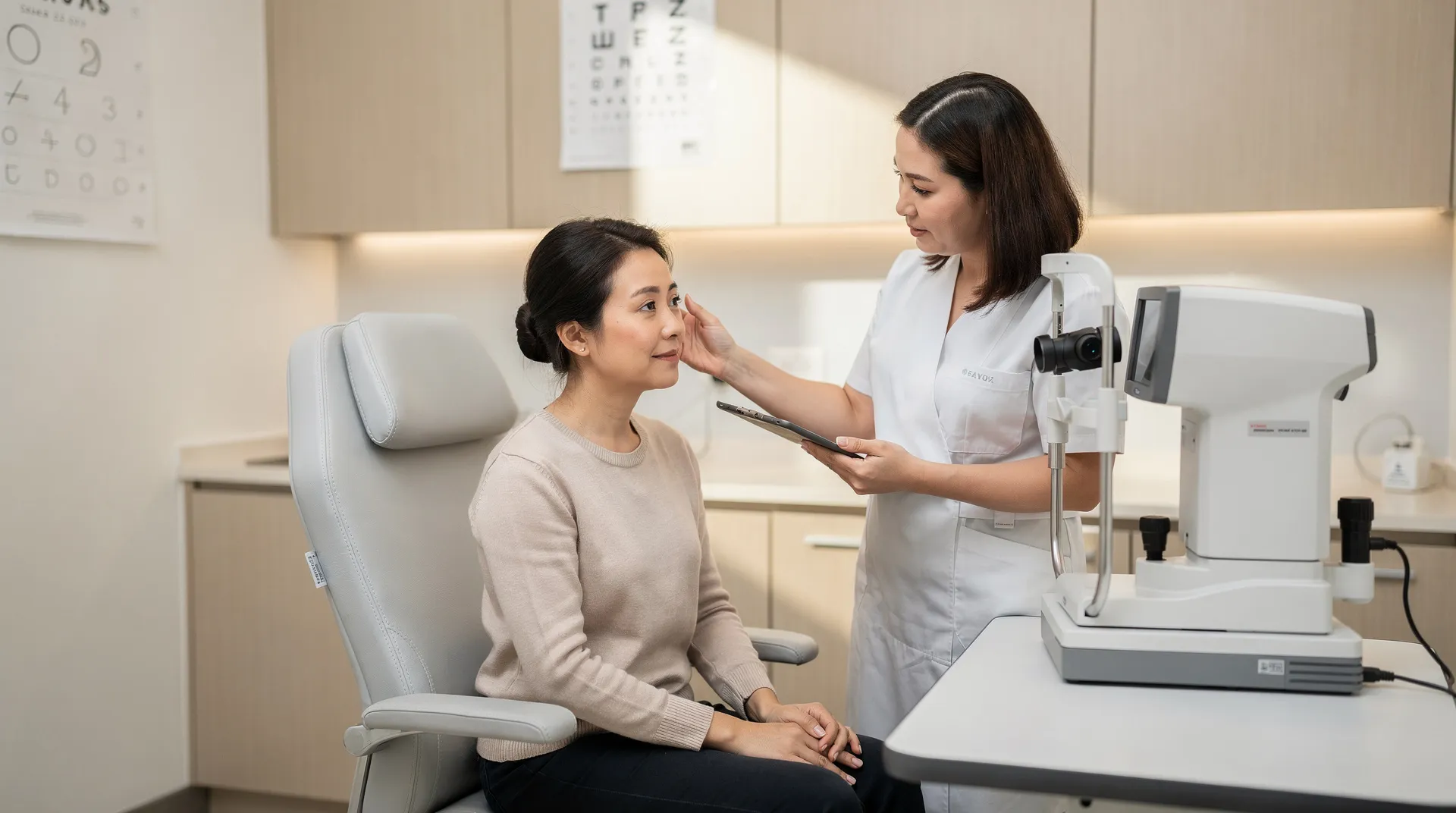
A LASIK evaluation tests your vision, checks for other eye problems, and measures and maps the thickness and surface of your cornea so the laser can be programmed for your eye. Those findings matter because another eye problem can affect the procedure, and LASIK may make some problems worse; dry eyes, for example, may be worse after LASIK. Bring a complete account of your current vision, contact-lens use, eye symptoms, and medical history so the examination addresses the factors that could change the recommendation.
Age does not provide a complete answer by itself. At age 73, LASIK may be possible if you have no or only minimal signs of non-visually significant cataracts and the rest of your eye examination is completely normal. That example does not establish your suitability; it shows why the examination and the condition of your eye matter more than an age cutoff alone. Discuss any age-related lens changes during the evaluation instead of assuming that age either qualifies or excludes you.

Know what happens during the LASIK procedure
The LASIK procedure reshapes the cornea through a defined sequence. Your eye is numbed with drops, and an eyelid holder helps keep you from blinking while a suction ring helps keep the eye from moving. You may feel firm pressure on the eyelid, and vision may briefly become dim or black.
The main steps are:
- A microkeratome or laser creates a paper-thin flap in the cornea.
- The surgeon lifts and folds the flap back.
- You look at a target light while a computer-programmed laser reshapes the corneal tissue using measurements taken for your eye.
- The flap is returned to position and attaches on its own in 2 to 3 minutes.
The 2-to-3-minute figure describes flap attachment after it is repositioned; it does not describe your entire appointment or the complete period of visual recovery.
Knowing the sequence helps you ask better questions about your own measurements and the plan for each eye. It also explains why accurate preoperative mapping matters: the laser treatment is programmed from the measurements of your cornea and refractive error rather than from a generic setting. Ask what your evaluation measured and how those measurements determine the proposed treatment.

Set recovery expectations before weighing the benefits
LASIK recovery has more than one meaningful time point. Vision is generally good within a few days, but the eye may take up to 2 to 3 months to heal completely and for vision to stabilize. Other FDA guidance allows that vision may take up to 3 to 6 months to stabilize, with glare, halos, difficulty driving at night, and other visual symptoms persisting during that period. These ranges should be treated as planning boundaries rather than a personal forecast.
Immediately after surgery, your eye may burn, itch, or feel as if something is in it. Discomfort, mild pain, tearing, hazy or blurry vision, light sensitivity, glare, starbursts, halos, and redness may also occur. These symptoms should improve considerably within the first few days, and you should plan on taking a few days off work until they subside.
Plan around the recovery you may experience, not only the first improvement in vision. Ask how follow-up will assess healing and whether your work, driving, exercise, travel, or night-driving plans need modification. If visual symptoms persist during stabilization, the appropriate response is follow-up with the doctor who is managing your care rather than assuming that the early view represents the final result. A short period of clearer vision does not necessarily mark the end of healing.

Balance reduced dependence on glasses with limitations and risks
LASIK may reduce your need for corrective lenses, but the relevant benefit is practical rather than absolute. You may be able to stop wearing glasses or contacts for most daily activities after LASIK. LASIK cannot fix presbyopia, so you may still need single-vision glasses or contacts at some point. You might also need glasses for reading or driving at night, and perfect vision without glasses or contacts is not guaranteed.
The eye surface is part of the trade-off. Dry eyes may occur after LASIK, and an eye doctor might recommend eye drops. For severe dry eyes, the doctor may recommend additional management such as tear-drain plugs or medicated eye drops. Existing eye problems can affect the procedure, and LASIK may make some problems worse, so dry-eye symptoms belong in the candidacy discussion before you choose a procedure.
You may notice increased light sensitivity, glare, halos around bright lights, or double vision after LASIK; these symptoms usually last a few days to a few weeks. Visual effects during the longer stabilization period can also include glare, halos, or difficulty driving at night. Ask how your work and evening activities fit into that possibility, especially if night driving is a regular part of your life.
The treatment can also leave a refractive error that needs further management. If the laser removes too little tissue, an undercorrection may result; undercorrections are more common in people who are nearsighted, and another LASIK procedure may be needed within a year. If the laser removes too much tissue, an overcorrection may result and may be more difficult to fix than an undercorrection. Uneven tissue removal can cause astigmatism that may require another surgery, glasses, or contact lenses. You may still need glasses or contacts after LASIK, and another surgery may be considered for some refractive errors.
Put these limitations beside the benefit when you make your comparison. If your main goal is reading without glasses, ask how presbyopia affects the plan. If your main concern is night driving, ask specifically about glare, halos, double vision, and the possible stabilization period. If you already have dry-eye symptoms, ask how they affect candidacy and what management could be needed. A useful decision weighs the activities you want to change against the visual tasks that may still require correction.
Compare PRK when corneal structure or lifestyle changes the choice
PRK is a separate corneal procedure, not simply a slower version of LASIK. PRK removes the outer corneal epithelium and then reshapes the cornea with an excimer laser. LASIK creates and lifts a hinged corneal flap before the laser reshapes the tissue. The difference affects which anatomical and lifestyle questions deserve attention.
| Decision question | LASIK | PRK |
|---|---|---|
| What changes? | A hinged corneal flap is lifted, and an excimer laser reshapes the cornea. | The outer corneal epithelium is removed, and an excimer laser reshapes the cornea. |
| What recovery trade-off may matter? | Compared with PRK, LASIK may provide earlier stabilization, faster visual-acuity improvement, less postoperative discomfort, shorter medication use, and an easier enhancement procedure. | PRK can involve postoperative pain, slower visual recovery, haze, and infection, although it can produce good visual outcomes. |
| When might anatomy affect the choice? | A flap-based approach may not be ideal for every corneal shape or thickness. | PRK may be preferred for certain anatomy or conditions, including central corneal thickness below 500 microns, a residual stromal bed that may be less than 200 to 300 microns, flat corneas below 41D, steep corneas above 48D, and some corneal or orbital conditions. |
| When might lifestyle affect the choice? | Ask how a flap may fit your activities and exposure to eye trauma. | We recommend PRK instead of LASIK when you are likely to receive direct blows to the eye, such as in professional martial arts or boxing. |
The measurements in the comparison are clinical thresholds, not home tests. A corneal thickness below 500 microns, a residual stromal bed that may be less than 200 to 300 microns, a corneal curvature below 41D or above 48D, an epithelial basement membrane condition, recurrent corneal erosions, narrow eyelid openings, or deep-set orbits can change the discussion. Ask which finding applies to you, how it affects the procedure choice, and what recovery would require before treating PRK as a fallback or LASIK as the default.
Use your activities and examination findings together. Tell the ophthalmologist about work, sports, or other situations in which your eyes could receive a direct blow, and ask whether the corneal measurements favor a surface-based procedure. The decision should come from the combination of your anatomy, refractive error, eye health, and recovery priorities rather than from recovery speed alone.
Consider implantable lenses when corneal surgery may not fit
Implantable lenses take a different route from corneal reshaping. Refractive surgery can alter the cornea, place a phakic intraocular lens in front of the natural lens, or replace the natural lens through refractive lens exchange. In some circumstances, an ophthalmologist may consider an intraocular procedure instead of corneal refractive surgery. We may use ICLs when you have irregular corneas, dry eyes, or a prescription outside the acceptable range for LASIK or PRK.
| Decision question | Corneal procedures such as LASIK or PRK | Implantable lens discussion |
|---|---|---|
| What is changed? | The cornea is reshaped with a laser; LASIK uses a flap, while PRK removes the surface epithelium first. | A phakic lens may be placed in front of the natural lens, or the natural lens may be replaced through refractive lens exchange. |
| Why might it enter the discussion? | The corneal measurements, eye health, prescription, and expectations must fit the selected procedure. | An intraocular procedure may be considered when corneal surgery is not a suitable route in some circumstances. |
| What findings does our practice identify for ICL? | Irregular corneas, dry eyes, or prescriptions outside the acceptable LASIK or PRK range may lead to discussion of another option. | We offer ICL when you have severe dry eyes, severe allergy or other ocular-surface disease, thin corneas with calculated residual pachymetry after LASIK below 250 u, large pupils, corneal scars, or abnormal corneal shape starting at -3.00 D. |
The threshold of -3.00 D in our ICL criteria describes the starting prescription for the abnormal-corneal-shape group; it is not a universal rule for every person considering an implantable lens. Ask which category your findings fit, whether the natural lens would remain in place, how the procedure differs from corneal surgery, and what follow-up the proposed option requires. The aim is a finding-based comparison, not a race to choose the procedure with the most appealing name.
Treat the ICL criteria as a reason to ask focused questions, not as a diagnosis or a self-selection rule. Severe dry eye, ocular-surface disease, corneal thickness, pupil size, scars, corneal shape, and prescription strength can each affect the discussion. An examination must determine whether an implantable lens is appropriate for your eyes and goals.
Turn the consultation into a complete comparison
A LASIK consultation should leave you with answers you can compare, not only a recommendation. Bring the same questions to any evaluation so you can separate clinical fit from convenience, advertising language, or an attractive starting price. Write down the proposed procedure, the reason it was selected, the alternatives considered, and the recovery assumptions attached to it.
Ask questions in five groups:
- Evaluation and candidacy: What will you measure in my vision, corneal thickness, corneal surface, and overall eye health? Has my prescription been stable enough for the proposed procedure? Could dry eye or another eye problem change the recommendation?
- Surgeon and technology: Who will perform the procedure? What training and experience does that surgeon have with LASIK, PRK, and implantable lenses? Which measurements and laser platform will be used for my eyes, and how will the plan be adjusted to those measurements?
- Alternatives: Why is LASIK being recommended instead of PRK or an implantable lens? What finding makes another option more suitable, if one does? What limitations should I expect with each option?
- Follow-up and recovery: How soon will follow-up occur? Who should I contact if pain, vision, or other symptoms worsen? What restrictions apply to work, driving, exercise, eye rubbing, and contact-lens use?
- Total cost and financing: What is the total price for both eyes and the full course of care? What is included in the evaluation, procedure, medications, follow-up visits, and possible enhancement discussion? Which costs are separate? What financing amount, payment schedule, interest, fees, cancellation terms, and eligibility requirements would apply to me?
Write down the answers and identify any point you do not understand before making a decision.
A useful comparison sheet can fit on one page. Record the findings that support or limit each procedure, the expected early recovery, the possible longer stabilization period, the follow-up schedule, and the full financial terms. Include what happens if you still need glasses, if symptoms persist, or if further correction is discussed. Comparing these details side by side makes it easier to distinguish a clinical recommendation from a promotional price or a broad promise.
Cost questions deserve the same precision as candidacy questions. Ask whether the quoted amount covers one or both eyes, the evaluation, the procedure, medications, postoperative visits, and any discussion of further correction. Ask which services or supplies could create a separate charge, and request the financing terms in writing so the total obligation, payment schedule, interest, fees, and eligibility conditions are clear before you commit.
Prepare for evaluation and protect the eye afterward
LASIK preparation starts before the baseline evaluation if you wear contact lenses. Contact lenses can change the shape of the cornea for up to several weeks after you stop wearing them, so stopping for too little time may lead to inaccurate measurements and a poor surgical plan. FDA guidance specifies these preparation periods before the initial evaluation:
- Stop soft contact lenses for 2 weeks.
- Stop toric soft lenses or rigid gas-permeable lenses for at least 3 weeks.
- Stop hard lenses for at least 4 weeks.
Ask the evaluating doctor whether your lens type or eye measurements require a different plan. Do not shorten the interval simply to keep an appointment; accurate baseline measurements are part of deciding whether a procedure fits.
Prepare for the procedure itself by arranging for someone to drive you to and from surgery. Medication may still affect you, and your vision may be blurry immediately afterward. Avoid eye makeup, cream, perfumes, and lotions on the day before and the day of surgery. Your eye doctor may also recommend cleaning your eyelashes daily or more often beforehand.
After LASIK, do not rub your eye. Rubbing could dislodge the flap and require further treatment. If further correction or an enhancement is considered, wait until eye measurements are consistent for two consecutive visits at least 3 months apart before re-operation. That timing is a condition for evaluating a further procedure, not a promise that an enhancement will be needed or appropriate.
Before leaving the procedure, make sure you know which symptoms are expected, how to reach the responsible doctor, and when the first follow-up will occur. Arrange your ride and time away from work in advance, keep your hands away from the treated eye, and follow the instructions provided for your own recovery. If your symptoms worsen rather than improve, use the urgent contact plan instead of waiting for a routine appointment.
Act promptly when pain or vision is getting worse
Worsening symptoms after LASIK require a different response from ordinary early discomfort. Contact your doctor immediately rather than waiting for a scheduled visit if you have severe pain or if your vision or other symptoms get worse instead of better. Do not rub the eye while waiting for instructions. Keep the responsible doctor’s contact information available before surgery so you can act without searching for it during recovery.
Do not try to explain away severe pain or declining vision as part of a normal timeline. Contact the doctor responsible for your postoperative care first and describe what changed, when it changed, and whether the symptoms are worsening. If you cannot reach that doctor promptly, seek qualified urgent eye care rather than delaying care while you wait for a scheduled visit.
Use an evaluation to choose the next step
A LASIK evaluation is most useful when you bring a clear goal and a complete set of questions. Ask whether your prescription, corneal measurements, eye health, and expectations support LASIK; compare PRK or an implantable lens when the findings point elsewhere; and discuss recovery, ongoing lens needs, follow-up, total cost, and financing before you decide. A qualified ophthalmologist must determine whether any option is suitable for your eyes. We offer free consultations to determine candidacy for LASIK or other corrective eye surgeries.
Take your prescription history, contact-lens details, eye symptoms, and written questions to that evaluation. Leave with a clear explanation of why a procedure is or is not being considered, what alternatives fit the findings, how recovery will affect your schedule, and what the complete financial terms include. If severe pain or worsening vision develops after surgery, contact the responsible doctor immediately rather than waiting for routine follow-up.