
Start with what fuzzy vision can—and cannot—tell you
Fuzzy vision is a symptom, not a cataract diagnosis. Blurred or cloudy sight, halos around lights, and colors that seem less bright can occur with cataracts, but those symptoms alone do not confirm that a cataract is present. Blurred vision can also be temporary and related to tired or dry eyes. Abrupt or ongoing changes deserve evaluation because they may reflect an underlying eye condition.
The useful first question is not simply whether your sight feels less sharp. Ask what changed, how quickly it changed, whether it affects one or both eyes, and whether the change is affecting ordinary tasks. A gradual haze and glare pattern may lead to a cataract discussion, while a sudden change or a symptom accompanied by pain needs a different level of attention. Keep those possibilities separate until an eye examination provides more information.
Your next step can begin with a short account of the symptom:
- Note whether the change appeared suddenly or gradually.
- Note whether the blur is brief, recurring, or present most of the time.
- Notice whether the change affects reading, driving, recognizing faces, or other regular activities.
- Record associated symptoms such as glare, halos, pain, redness, flashes, lines, darkness, or shadows.
A brief change that settles and does not return can be recorded while you watch for a pattern, but recurring, persistent, or abrupt blur should move you toward an eye examination rather than a cataract assumption. Sudden visual symptoms with warning signs require prompt eye care. The symptom timeline gives you something concrete to describe when you seek help.
Keep the record descriptive rather than diagnostic. Recording that blur returns during reading is an observation; deciding that the cause is a cataract is a conclusion the examination has not established. This distinction helps you preserve details that could point to another contributor. If the pattern changes while you are observing it, update the record instead of treating the first description as final. The goal is not to prove a cause at home. It is to preserve the sequence of changes, associated symptoms, and effects on daily activities so the evaluation starts with useful information.
Notice patterns that may point toward cataracts
Cataract-related vision changes can include cloudiness, glare, halos around lights, harder night or low-light vision, and colors that gradually appear less vivid. These clues can help you describe what has changed, but they cannot establish the cause by themselves. A similar complaint may arise from a different eye condition or from a temporary surface problem.
Night driving can make the pattern easier to notice because headlights and other lights may produce glare or halos. Low light can also expose a reduction in visual clarity that is less obvious in bright conditions. Treat those observations as useful information for an examination, not as a home test for cataracts. If the change is affecting how you move through familiar settings, write down the specific task that has become harder.
Cataracts have more than one type, and their position in the lens can affect how the clouding develops. The most common type occurs in people over age 40 and forms mainly in the center of the lens. A posterior capsular cataract forms toward the back of the lens and usually develops faster than nuclear and cortical cataracts.
Those categories add context, but they do not let you identify your own cataract from symptoms alone. You do not need to name a cataract type before arranging an examination. If glare, halos, low-light difficulty, or reduced color intensity is changing how you function, bring that pattern to an eye-care professional and let the examination address the cause.
Keep temporary blur and other contributors in view
Temporary blurred vision can be related to tired or dry eyes, while abrupt or ongoing blur may reflect an underlying eye condition that should be evaluated. That distinction prevents every episode of fuzzy sight from being treated as evidence of a cataract. It also prevents a persistent change from being dismissed as fatigue without further attention.
The time pattern gives you useful context. A short episode after a demanding day is different from blur that keeps returning, gradually worsens, or remains present. The pattern does not provide a diagnosis, but it helps you explain why you are seeking care and how quickly the change deserves attention. Record when the blur starts, how long it lasts, and whether rest changes it.
Stress is not a common cause of blurred vision. Medical guidance describes a possible relationship between stress and visual symptoms, while a single study from 2018 associated higher anxiety levels with an increased risk of conditions such as glaucoma and dry eye syndrome. That association does not establish that stress caused your visual change.
A practical symptom note can include sleep, eye comfort, the timing of blur, and whether the problem is becoming more frequent. Use those details to support a focused eye-care conversation. Do not use stress, fatigue, or dryness as a reason to disregard a sudden or persistent change.
Recognize warning signs that should not wait
The combination matters. A new visual disturbance with pain or marked redness is different from a slow, painless haze. A sudden shower of spots or flashes is different from a stable difficulty reading. Describe exactly what you see, when it began, whether one or both eyes are affected, and whether the change is getting worse when you contact an eye-care service.
Glaucoma may have no obvious warning signs in its early stages. As it progresses, it can cause blind spots in peripheral vision or, less commonly, central vision. The absence of pain or a dramatic symptom does not establish that everything is normal.
Prompt care is the boundary for sudden flashes, lines, darkness, shadows, severe eye pain, or a red eye with blurred vision. An ongoing change without those warning signs still supports arranging an eye examination, especially when it begins to interfere with regular activities. Do not wait for a gradual problem to become dramatic before mentioning it.
Use daily activities to decide whether an eye examination is due
Daily function gives you a practical way to choose between cautious observation and an eye examination. Brief blur that settles and does not recur can be observed while you record the pattern, but ongoing or abrupt change should be evaluated because it may reflect an underlying eye condition. Vision problems that make regular activities difficult are a reason to discuss cataract surgery with an ophthalmologist.
Use these three checkpoints:
- Brief and settling: Record when the symptom occurs and whether it returns. Arrange an examination if the change persists, recurs, or becomes more noticeable.
- Ongoing or changing: Arrange an eye examination rather than trying to identify the cause from symptoms. Bring your timeline and the activities that have become harder.
- Interfering with regular activities: Ask whether cataract findings are present and whether treatment should be part of the discussion. Difficulty with daily function is a point for conversation, not an automatic instruction to have surgery.
This approach keeps the decision tied to the pattern and its effect on your life. It does not turn symptom tracking into a substitute for an examination.
Adults over 60 have an additional planning point from our eye-care guidance: we recommend scheduling annual eye exams. That recommendation does not explain every episode of blur or determine whether cataract surgery is needed. It gives you a recurring opportunity to discuss changes before they become the only reason you seek care.
The practical boundary is simple: use observation only for a brief, non-worsening pattern, and move to an examination when the symptom persists, changes, or affects what you do. Use prompt eye care for sudden dots, lines, flashes, darkness, shadows, severe eye pain, or a red eye with blurred vision.
What an examination can clarify about a possible cataract
An eye examination can move the conversation from symptom matching to an assessment of what may be affecting your sight. Blurred or cloudy vision, halos, and less-bright colors can occur with cataracts, but symptoms alone do not confirm a diagnosis. Persistent or abrupt blur also deserves evaluation because cataracts are not the only possible explanation.
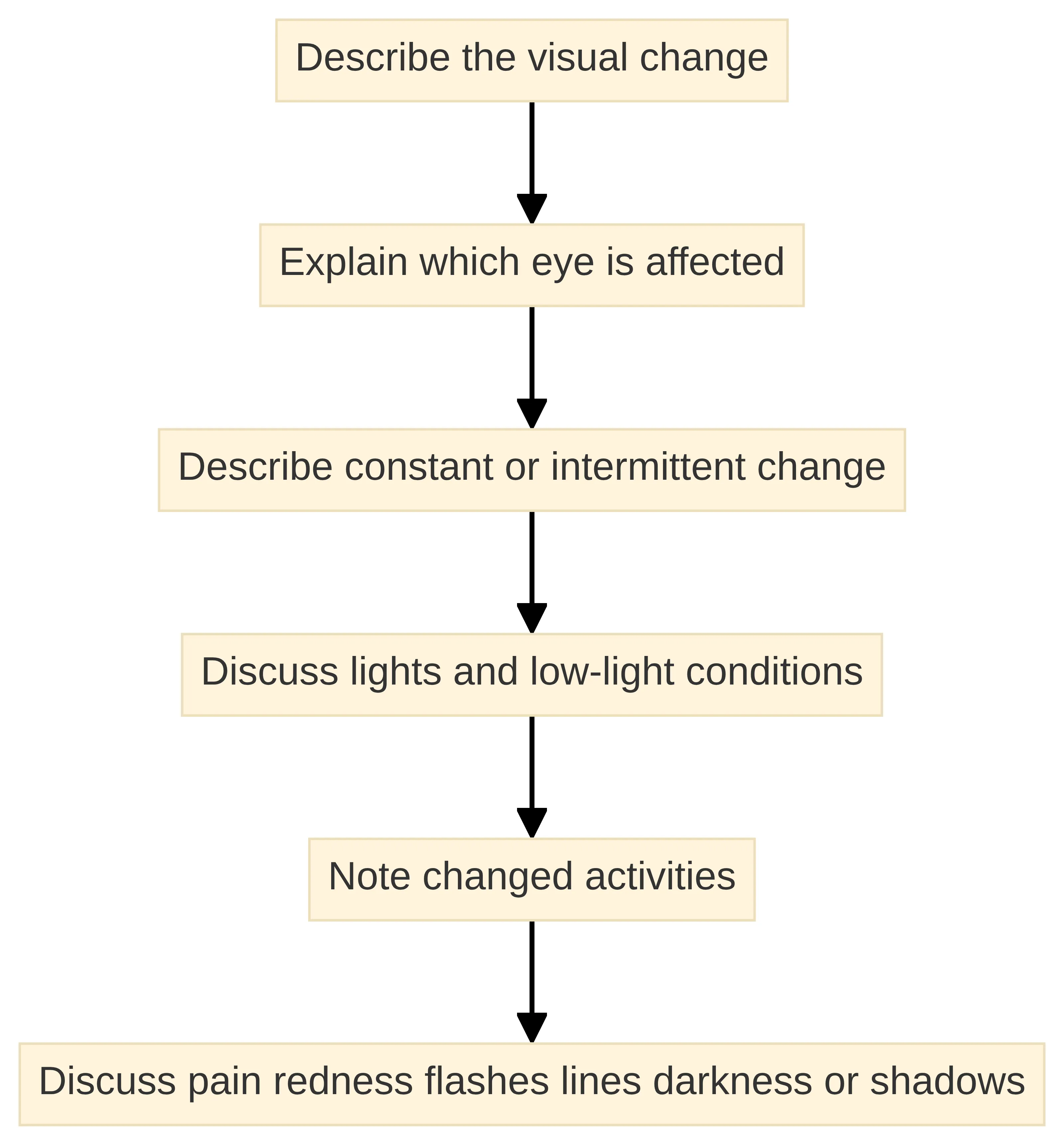
Bring a concrete description rather than relying on the phrase fuzzy vision alone. Explain which eye seems affected, whether the change is constant or intermittent, what happens around lights, whether night or low-light conditions are harder, and which activities have changed. Mention dryness, fluctuating clarity, pain, redness, flashes, lines, darkness, or shadows. Those details give the clinician a clearer starting point for discussing what the examination shows.
That distinction separates several questions that are easy to blend together. One question is what may be affecting your sight. Another is whether the examination identifies cataract-related lens clouding. A third is whether treatment should be discussed and, if so, which options fit the findings and your daily goals. Symptoms can begin that conversation, but they do not answer all three questions. If the examination points to a cataract, the next discussion can connect the finding with timing and an IOL. If it points elsewhere, the symptom description still helps keep the conversation focused on the relevant contributor rather than on an assumed cataract.
Cataract surgery involves removing the clouded lens and replacing it with an artificial lens called an intraocular lens, or IOL. If an examination identifies a cataract, that basic procedure description gives you a foundation for a more specific conversation about timing, lens goals, preparation, recovery, costs, and possible complications.
An examination and discussion are still needed before you connect the procedure with your own situation. Prepare questions about what is causing the visual change, whether a cataract is involved, what other contributors need attention, and which decisions would follow from the findings. The presence of a symptom does not by itself establish that surgery is appropriate.
Connect cataract treatment timing to everyday function
Cataract treatment timing is generally a discussion about how vision affects your regular activities, not a fixed number on a calendar. When cataract-related vision problems make ordinary tasks difficult, the American Academy of Ophthalmology guidance supports discussing cataract surgery with an ophthalmologist. That point does not mean every difficult visual task requires surgery; it identifies when a treatment conversation becomes reasonable.
Describe the practical effect in concrete terms:
- Are glare or halos changing how you manage lights or night conditions?
- Has reduced clarity made reading, household tasks, or other familiar activities harder?
- Are you changing routines because your sight no longer feels dependable?
- Has the change continued despite the possibility of tired or dry eyes?
Cataract surgery removes the clouded lens and replaces it with an IOL. The decision about timing connects that procedure with the findings from an examination and the way your vision is affecting daily life.
Laser-assisted cataract surgery and standard ultrasound phacoemulsification should not be compared from a label alone. In a Cochrane comparison, corrected distance visual acuity at 1 to 3 months had a reported mean difference of −0.00 with a range of −0.01 to 0.01 between the two approaches. That number describes the reported group comparison at that time point; it is not a prediction of your own result or a decision about which approach fits you.
Ask what the available approach means for your examination findings, procedure plan, recovery discussion, and overall costs. Keep the comparison tied to those concrete questions rather than treating one technique name as an automatic answer. A treatment conversation should address your findings and daily goals, not only the procedure label.
The selected comparison is useful as a limit on what can be inferred, not as a complete decision rule. It reports corrected distance visual acuity at one follow-up range, from 1 to 3 months. That result does not by itself answer questions about reading priorities, ocular-surface findings, preparation, recovery, possible complications, or costs. It also does not turn a group-level comparison into a forecast for one person. When discussing the approaches, ask which outcomes matter for your decision and whether the available evidence addresses those outcomes. This keeps a single reported measurement in context while leaving the clinical choice connected to the examination and your priorities.
Turn distance and reading goals into lens questions
Distance and reading goals belong in the IOL discussion because cataract surgery replaces the clouded natural lens with an artificial intraocular lens. Your priorities may include seeing clearly across a room, reading printed material, using a phone, driving, or managing close work. State those priorities plainly instead of asking for a lens choice without explaining how you use your sight.
Before deciding, ask an ophthalmologist:
- Which IOL approaches are available for my distance and reading priorities?
- What visual tasks would each approach be intended to support?
- Would I still be likely to use glasses for particular distances or activities?
- What limitations, possible visual effects, or complications should I understand?
- How would the lens discussion change if another eye condition or ocular-surface problem is present?
- What information from the examination determines whether an option is appropriate for me?
These questions keep the discussion focused on your actual routine. They also leave room for the clinician to explain which choices are available and which are not appropriate for your findings.
A lens conversation should cover more than the distance you hope to see. Ask how reading, night conditions, work demands, and your willingness to use glasses fit into the plan. Ask for a plain explanation of the benefits and possible complications before you decide.
You can also separate goals from assumptions:
- A desire to read without glasses is a goal to discuss, not a guaranteed result.
- A desire for clear distance vision is a goal to describe, not proof that a particular IOL is suitable.
- Interest in a premium or advanced lens option is a question about availability, trade-offs, cost, and examination findings.
The useful outcome of this preparation is a set of questions you can take into an examination. It is not a promise that a particular lens option will be offered, suitable, covered, or able to meet every visual goal.
Before the discussion, rank the activities that matter most rather than listing every goal as equally important. You might identify distance vision, reading, phone use, night conditions, work demands, and willingness to use glasses as separate priorities. Then ask how the available IOL approaches relate to that order. If two priorities cannot be treated as identical, ask the ophthalmologist to explain the relevant limitations and possible visual effects in plain language. This gives the conversation a decision criterion: not simply which option sounds most advanced, but which questions need clear answers for the way you actually use your sight. Keep the list open to revision after the examination, because the findings determine which choices are appropriate to discuss.
Ask about preparation, recovery, costs, and coverage
Preparation, recovery, benefits, possible complications, and costs belong in the cataract-surgery conversation before you decide. General information cannot give you an individualized recovery schedule or activity plan, so use the appointment to ask for the details that apply to the proposed procedure.
Take this question list with you:
- What preparation is required before surgery?
- What should I expect during recovery, and which activities may need to change while I recover?
- Which symptoms during recovery should prompt a call or another examination?
- What benefits and possible complications should I weigh?
- Which parts of the procedure, testing, facility care, medicines, and follow-up are included in the quoted cost?
- What deductible, copay, coinsurance, or authorization questions should I take to my insurer?
- Could an IOL option or related service create a separate out-of-pocket expense?
- Which costs should I ask the practice to explain before making a decision?
The American Academy of Ophthalmology guidance supports discussing the procedure, preparation, recovery, benefits, possible complications, costs, and other questions with an ophthalmologist. Use that conversation to replace assumptions with specific answers about your plan.
Insurance questions need their own place in the conversation. Ask your insurer which questions apply to your plan, including deductibles, copays, coinsurance, authorization, facility charges, and any separate expense connected with an IOL option. Ask the practice to explain the charges associated with the proposed care plan.
Do not treat a general description of cataract surgery as a coverage decision for your policy. Write down the insurer, plan, deductible, copay, and authorization contact before the discussion if those details are available to you. A written list helps you separate clinical questions from financial questions and identify what still needs an answer.
A two-part checklist can make that separation clearer. Under clinical questions, record what the examination shows, what preparation and recovery involve, which benefits and possible complications should be weighed, and how lens goals relate to the proposed plan. Under financial questions, record what the insurer and practice need to clarify about the procedure, facility care, medicines, follow-up, authorization, and any IOL-related expense. Take the unanswered items to the appropriate person rather than filling gaps with assumptions. This approach keeps a cost question from being mistaken for a clinical recommendation and keeps a lens preference from being mistaken for a coverage determination.
Use the list as an answer-tracking tool rather than as a substitute for verification. Mark each item as answered, needing clarification, or still unconfirmed. Ask the ophthalmologist to explain clinical items, and ask the insurer and practice to verify the financial details for the proposed care. This guide does not set a universal recovery timetable or activity restriction, and it does not determine what an insurer will pay. Keep those questions open until the relevant person answers them. That process prevents a general discussion of recovery from being treated as personal instructions and prevents a lens preference or a general cost description from being treated as a coverage determination. Before the appointment, write the exact activities you want to discuss and the cost items you need explained. Then ask which answer belongs to the clinician, the practice, or the insurer.
Use the same wording when you ask about a cost item: name the procedure or service being discussed, identify whether the question is about a deductible, copay, authorization, facility charge, medicine, follow-up, or IOL-related expense, and record who supplied the answer. This creates a clear handoff without assuming that one person’s answer covers the others or applies to every option.
Account for the ocular surface before lens decisions
A healthy ocular surface supports best vision, and dryness or an irregular tear film can affect lens-power measurements before cataract surgery. Those measurement changes may leave residual farsightedness, nearsightedness, or astigmatism after surgery. Mention dry-eye symptoms, fluctuating clarity, or other surface concerns before lens measurements are used in the discussion.
The point is not to label every fluctuation as dry eye. The point is to keep the surface of the eye in view alongside the lens clouding. Ask how the examination accounts for the ocular surface and whether any finding changes the timing or interpretation of lens measurements. This question belongs before you treat a lens discussion as a simple choice between distance and reading goals.
Use the ocular-surface discussion as a checkpoint in the sequence of decisions: first describe fluctuating clarity or discomfort, then ask how those findings relate to lens-power measurements, and only afterward compare distance and reading goals. This does not mean that a surface concern automatically rules out cataract treatment. It means the lens conversation should include the condition of the eye being measured. Keeping these questions together can help explain why ocular-surface findings belong beside lens clouding and visual priorities, rather than treating the IOL as an isolated choice.
One reason this checkpoint matters is that the ocular surface is part of the eye’s optical system, not merely a comfort issue. The cornea and tear film contribute to the eye’s optical power, while the lens supplies the remaining portion. If the tear film is irregular, measurements used to choose IOL power may be affected and may not represent a stable basis for the decision. That is why fluctuating clarity deserves a different question from steady haze: ask how surface findings are considered before treating a measurement as final. This does not predict a residual refractive error for any individual. It explains why surface status belongs in the sequence before lens-power decisions and why a dry-eye flare should be included in preparation and recovery questions.
If a clinician raises an ocular-surface issue, ask what observation supports that concern and whether it changes the interpretation of the lens measurement.
Cataract surgery can sometimes temporarily worsen ocular-surface disease or trigger a dry-eye flare. Ask what that possibility means for your preparation and recovery conversation, and ask which symptoms should be reported during follow-up.
A focused question can connect the pieces: how will the proposed IOL discussion account for current dryness, an irregular tear film, or fluctuating vision? The answer should remain tied to your examination findings rather than to a general promise about lens performance. Include any history of surface discomfort when you describe what has changed.
Choose a focused next conversation
Persistent or changing blurred vision deserves a clearer answer than symptom matching can provide. Use the pattern of change to choose between cautious observation, an eye examination, and prompt eye care; if cataract-related difficulty is affecting regular activities, include timing, IOL goals, recovery, costs, and coverage in the discussion.
A qualified eye-care professional must determine what your symptoms mean, whether cataract surgery is suitable for you, which lens options fit your findings, and how your insurance applies. Bring your symptom timeline and question list so the conversation can stay focused. We provide a free consultation for individuals seeking help with cataracts.
For a focused conversation, have three points ready: what changed in your vision, which daily activities are harder, and what you want to understand about cataract treatment. Include warning symptoms, the timing of the change, and any concerns about dryness or fluctuating clarity. That preparation helps you ask the right clinical questions without assuming a diagnosis or a treatment outcome.