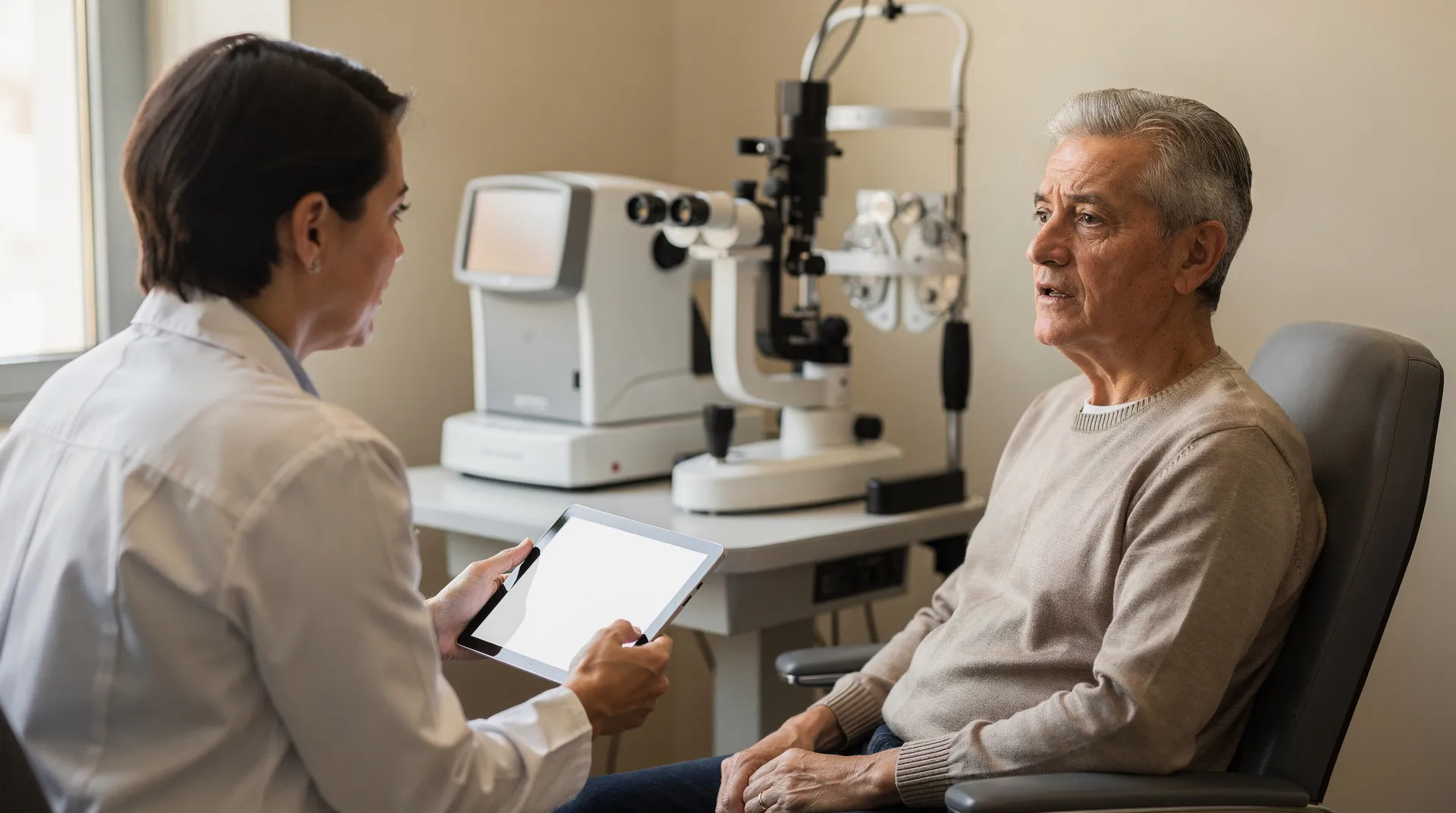
Turn the search for glaucoma care into a provider decision
The right place to begin glaucoma care is a qualified ophthalmology evaluation, not a procedure name or a convenient address by itself. Your first comparison should be whether the practice can establish a useful picture of your eyes, connect the findings to reasonable treatment discussions, and continue measuring your response over time.
Use five questions to organize the search:
- What does the evaluation measure, and how will the findings be explained to you?
- Can the ophthalmologist discuss medication, laser treatment, and surgical pathways when the findings call for them?
- How will eye pressure, the optic nerve, and visual fields be monitored after treatment begins?
- Who will manage follow-up if your treatment changes or you have a concern?
- Can you reach the practice, provide prior records, and attend the follow-up schedule it recommends?
For primary open-angle glaucoma, patients typically have three treatment categories to discuss: eyedrops, laser surgery, or incisional surgery. That list is a starting point, not a self-selection tool. An ophthalmologist can help determine the appropriate option based on disease progression, tolerance of eyedrops, and other factors.
At DLV Vision, we offer clinical and surgical glaucoma evaluations as part of our subspecialty eye care. The useful next step is to compare that offering with other ophthalmology practices using the same questions, then request an evaluation from the option that fits your location and care needs.
Overview
A qualified ophthalmology evaluation is the direct answer to the first question: start with an eye-care practice that can evaluate glaucoma and explain how its findings shape the care plan. Then compare each location across evaluation, treatment scope, monitoring, access, and continuity rather than choosing from a treatment label alone.
A practical comparison looks like this:
- Evaluation: Ask whether the visit can assess visual acuity, the front of the eye, eye pressure, the optic nerve, visual fields, relevant medical history, and medication effects. Gonioscopy may be appropriate when angle or pressure concerns exist and periodically.
- Treatment discussion: Ask whether the ophthalmologist can explain medication, laser, and incisional pathways and why a particular approach may fit your findings, disease progression, and ability to tolerate eyedrops.
- Monitoring: Ask how the practice will compare later measurements with your starting findings and when therapy might be reconsidered.
- Access: Ask how you request an appointment, communicate a concern, transfer records, and arrange follow-up after an evaluation or procedure.
- Continuity: Ask who is responsible for follow-up and how the plan changes if pressure, optic-nerve findings, visual fields, or medication tolerance change.
DLV Vision offers clinical and surgical glaucoma evaluations as part of our subspecialty eye care. If its Westlake Village, California context is practical for you, include it in the same neutral comparison. Request the evaluation after you understand what questions you want answered and what records you can bring.
A useful location should give you more than a treatment label. It should give you a way to understand the starting findings, discuss the available paths, and know what happens after the first visit.

Verify that the evaluation can establish a useful starting point
A glaucoma evaluation should give you a meaningful starting point for comparing future findings, not just a single pressure reading. Ask the practice to explain which measurements it will perform, what each measurement contributes, and how the results will be documented for follow-up.
A glaucoma follow-up may include:
- Visual-acuity measurement, which records how clearly you see at the examination.
- Slit-lamp examination, which examines structures at the front of the eye.
- Intraocular-pressure measurement, which records pressure inside the eye.
- Optic-nerve-head evaluation, which assesses the appearance of the nerve that carries visual information.
- Visual-field evaluation, which assesses areas of vision that may not be represented by central visual acuity.
An evidence-based review describes optic-disc assessment and standard white-on-white visual-field testing as current gold standards for glaucoma diagnosis. That description does not mean every test has the same role or that you can interpret a result without the full examination. Ask how the practice will put the measurements together.
Gonioscopy may be performed when there is suspicion of an angle-closure component, a shallow anterior chamber, an angle abnormality, or an unexplained change in eye pressure, and it may also be performed periodically. Ask whether your evaluation includes this angle assessment when your findings make it relevant.
Before scheduling, use questions such as these:
- Which tests will establish the baseline for my eyes?
- How will you explain an eye-pressure result alongside the optic-nerve and visual-field findings?
- Will you review my current eyedrops, side effects, and the time I last used them?
- If an angle concern appears, how will you evaluate it?
- How will I receive the findings and the recommended follow-up interval?
The goal is not to collect the longest list of tests. The goal is to leave with a clear explanation of what was measured, what remains uncertain, and what should be watched next.

Compare treatment scope without choosing a procedure in advance
A glaucoma practice should be able to connect your examination findings to a treatment conversation. You do not need to decide in advance that eyedrops, laser treatment, or surgery is the right route; you need an ophthalmologist who can explain which paths apply to your condition and why.
For primary open-angle glaucoma, the typical treatment categories are:
- Eyedrops: Medication may be used to lower eye pressure. The discussion should include the dosing routine, possible side effects, and whether the schedule is realistic for you.
- Laser surgery: Laser treatment may be used to lower eye pressure, either as an initial or an additional treatment for primary open-angle glaucoma.
- Incisional surgery: If laser treatment and eyedrops are not enough, an ophthalmologist may recommend traditional glaucoma surgery, and some patients may be offered minimally invasive glaucoma surgery.
Eye pressure can be lowered with medication, laser surgery, incisional surgery, or combinations of these approaches. The relevant comparison is therefore not which treatment sounds most advanced. It is which approach, or combination, fits the findings, the course of the disease, your tolerance of medication, and the follow-up it requires.
Ask each practice:
- Which treatment categories are relevant to the type of glaucoma being evaluated?
- What finding would make medication, laser, or surgery worth discussing?
- If the first approach does not control the target pressure, what would be considered next?
- What daily responsibilities, visits, and monitoring accompany each option?
- Who will explain benefits, risks, expected follow-up, and alternatives before you decide?
A location that names a procedure without explaining the evaluation and decision process does not give you enough information to compare care.
Treatment discussions can also depend on the eye’s drainage anatomy. With narrow angles, cataract surgery can create more space for fluid to leave the eye and can lower eye pressure. A glaucoma drainage device may lower eye pressure by directing excess fluid to a collection area where nearby blood vessels absorb it. These examples show why asking which anatomical finding is being addressed can be more useful than asking which procedure is generally best.
Test how the practice handles daily treatment responsibilities
A glaucoma treatment comparison should include what you must do between appointments. Glaucoma eyedrops work only when they are used every day exactly as prescribed, but several practical problems can interfere with using them. Busy schedules, memory problems, arthritis, difficulty aiming the drops, missed refills, and cost can all make the routine harder to follow.
Use the consultation to discuss the real routine rather than giving a simple yes-or-no answer about whether you can use drops. Ask:
- How many times each day would the medication be used?
- What should you do if you miss a dose or cannot place the drop accurately?
- How will the practice address irritation, dry-eye symptoms, or other medication concerns?
- How will you request refills before the medication runs out?
- What should you do if the schedule becomes difficult because of work, travel, memory, hand strength, or cost?
Do not discontinue glaucoma eye drops without consulting your eye doctor. If the routine is difficult or the side effects are affecting your willingness to continue, contact the responsible eye-care professional rather than changing the regimen independently.
The practice should also explain how daily treatment connects to follow-up. Bring the names and directions for every eye medication to the appointment, including medicines you use for other eye conditions. Report how consistently you have been able to use each medication and any difficulty you have experienced. Those details help the ophthalmologist interpret a pressure measurement and decide whether the treatment plan needs discussion.
When you compare locations, treat practical support as part of the care process. A practice that invites questions about administration, refills, side effects, and missed doses gives you specific issues to discuss before you accept a long-term routine.
Ask how treatment response will be monitored over time
Glaucoma care is a monitoring process, so ask how the practice will tell whether treatment is meeting its goal. Treatment aims to control eye pressure in a target range and keep the optic nerve, retinal nerve fiber layer, and visual fields stable. A target eye pressure is an estimate that must be individualized and may be adjusted as the disease changes.
For patients in whom therapy is indicated, an ophthalmology management benchmark recommends an initial target pressure of at least 25% lower than pretreatment eye pressure. The 25% measures the proposed reduction from the pretreatment pressure; it is not a universal target for every person. A lower target can be justified by more severe or rapidly progressing damage or other risk factors.
Ask how the practice will monitor:
- Eye pressure against the individualized target range.
- The optic nerve and retinal nerve fiber layer for structural change.
- Visual fields for functional change.
- Medication use, side effects, and the time of the last dose.
- Changes in your ocular or systemic medical history.
- Whether the treatment plan remains tolerated and effective.
Glaucoma therapy may be adjusted when the target eye pressure is not achieved and the benefits of changing therapy outweigh the risks, when progressive optic-nerve damage occurs despite achieving the target, or when the prescribed medical regimen is not tolerated. Ask what findings would lead to a treatment discussion and how quickly that discussion would take place.
Follow your doctor’s instructions carefully and attend all follow-up appointments. Before choosing a location, ask who schedules those visits, how the practice communicates results, and what happens if you cannot attend at the recommended interval. A useful care plan should make the monitoring responsibility understandable to you.
Do not treat a target pressure as a number you can choose independently. It is a working estimate tied to the condition of your eyes and may change as measurements and disease findings change.
Compare laser and surgical pathways by setting and follow-up
A practice comparison should cover both where a procedure takes place and what monitoring follows it. Laser and incisional pathways are not interchangeable, and the setting alone does not tell you which approach fits your eyes.
| Pathway | What the treatment does or addresses | Setting and follow-up questions |
|---|---|---|
| Laser glaucoma procedure | Laser procedures help aqueous fluid drain from the eye. Laser trabeculoplasty treats the drainage angle with laser energy, helping it work better over time and lowering eye pressure. | Laser procedures are usually performed in an ophthalmologist’s office or an outpatient surgery center. Ask where your procedure would occur and how the practice will check your pressure and vision afterward. |
| Laser trabeculoplasty for primary open-angle glaucoma | It may be used as initial or adjunctive treatment. The treated portion may be 180 degrees or 360 degrees of the drainage angle; those figures describe the portion of the angle treated, not a success rate or a universal treatment plan. | Vision may be blurry for a couple of hours afterward, and your ophthalmologist may prescribe medicine for a few days. Plan transportation so you are not relying on yourself to drive immediately after the procedure. |
| Incisional glaucoma surgery | Incisional surgery may be recommended when laser treatment or medication is not enough to control eye pressure. It improves fluid outflow by creating a small surgical opening in the eye’s drainage system or sclera. | Follow-up checks assess vision, eye pressure, and the front of the eye. More frequent visits may be needed if postoperative complications occur. Ask who will perform those checks and how quickly you should report a concern. |
If laser peripheral iridotomy surgery is being discussed, ask about the pressure checks around the procedure. Eye pressure should be checked immediately before surgery and within 30 minutes to 2 hours after laser surgery; the 30-minute-to-2-hour interval describes the post-procedure check window.
Use these questions before agreeing to a pathway:
- What type of glaucoma or angle finding makes this procedure relevant?
- What will happen in the office, outpatient center, or operating room?
- What temporary vision changes or medication instructions should you expect?
- Which pressure, vision, and front-of-eye checks are planned afterward?
- Who should you contact if a symptom changes before the next scheduled visit?
A treatment location becomes easier to compare when it explains the procedure and the follow-up as one connected plan.

Use access and continuity questions to compare locations
Access matters because glaucoma care can involve an initial evaluation, treatment discussions, repeated measurements, medication questions, and follow-up after procedures. Compare how each practice handles the handoffs between those stages rather than judging access only by the first appointment.
Ask the practice:
- How do you request an initial ophthalmology or glaucoma evaluation?
- What information should you provide when scheduling?
- How do you communicate appointment instructions and examination findings?
- Who answers a question about medication use or a new concern between visits?
- How are outside records, prior pressure measurements, visual fields, and other reports received and added to your chart?
- Who owns the follow-up plan after a laser procedure or incisional surgery?
- If the treatment plan changes, how will the next appointment be arranged?
- What should you do if you cannot attend a scheduled follow-up?
Continuity also means knowing which clinician is responsible for explaining the next decision. Ask whether the evaluation, treatment discussion, procedure, and follow-up are handled within the same practice or require a transfer of care. If another clinician or facility becomes involved, ask how records and instructions will move between them.
You do not need a promise that every step will occur in one place. You need a clear process for keeping your findings, medication information, instructions, and follow-up responsibilities connected. Write the answers down for each location so a convenient appointment does not obscure an unclear plan.
A short comparison worksheet can keep access questions concrete. Record the answer under the same headings for every location:
- First contact: How do you request care, and what information must you provide?
- Records: How do you send prior examinations, pressure measurements, visual fields, and medication information?
- Communication: Who handles questions between visits, and how do you reach that person or team?
- Follow-up: Who explains the next appointment and what happens after a treatment or change in medication?
- Changes: How are new findings, missed appointments, or treatment changes communicated?
- Practical fit: Can you reasonably reach the location and attend the recommended schedule?
The answers help you distinguish an easy first appointment from a care process you can continue. Access is not only about distance or appointment speed; it also includes whether you can obtain instructions, transfer information, and reach the responsible eye-care team when the plan changes. Keep the worksheet with your questions and records so you can use it during the consultation rather than relying on memory afterward.
Build a cost and coverage question list
Cost questions belong in the first comparison, but an advertised procedure name rarely tells you the full financial structure. Ask the practice and your insurer separate questions about evaluation, testing, treatment, facility use, medication, and follow-up.
Use this worksheet:
- Which evaluation or diagnostic tests are planned at the first visit?
- Which tests and follow-up visits are billed separately from the evaluation?
- If laser treatment or surgery is discussed, is the professional fee separate from a facility or operating-room fee?
- Are postoperative examinations included in a procedure charge or scheduled and billed separately?
- Which medications, supplies, or transportation arrangements might be your responsibility?
- Does the practice provide an estimate of its charges before a procedure is scheduled?
- Which questions should you direct to your insurer about eligibility, deductibles, coinsurance, authorization, network status, or claims?
- What happens financially if the evaluation leads to a different treatment discussion than you expected?
Ask for the medical reason for each proposed service in plain language. A test may be part of evaluating the optic nerve, visual field, eye pressure, or drainage angle, while a follow-up visit may be needed to assess response or medication tolerance. Understanding the purpose helps you compare like with like without assuming that every location packages services in the same way.
Do not choose a location from a low initial price alone. Compare the written questions answered by the evaluation, the treatment and facility charges that may follow, the follow-up responsibilities, and the process for asking about a bill. Confirm financial details with the responsible practice and insurer before scheduling a procedure, because availability and coverage arrangements can change.
Separate four financial questions that are easy to combine accidentally:
- What is being evaluated? Ask which examination, testing, or consultation charge applies before you schedule.
- What treatment is being considered? Ask whether medication, laser treatment, or surgery would create different professional or facility charges.
- What follow-up is expected? Ask how postoperative checks, pressure measurements, or additional testing are billed if the plan changes.
- What does your coverage require? Ask your insurer about authorization, network rules, deductibles, coinsurance, and claims rather than assuming that a practice can answer every coverage question.
Ask for the response in writing when possible and record the date of the conversation. Do not use a quoted amount as a promise that the service will be available or that your coverage will apply. The purpose of this list is to identify the questions that need answers before you schedule treatment, not to predict an individualized bill.
Use DLV Vision in Westlake Village as one comparison option
If Westlake Village, California is a practical location for you, include DLV Vision in your comparison of glaucoma-care practices. We offer clinical and surgical glaucoma evaluations, as well as refractive surgery consultations, cataract evaluations, and general ophthalmology.
Use the same questions you would ask any ophthalmology practice:
- What does the clinical or surgical glaucoma evaluation include?
- Which findings will be reviewed before treatment options are discussed?
- How will the practice explain medication, laser, or surgical pathways when they are relevant to your findings?
- What follow-up arrangements should you understand before scheduling?
- Who should you contact about medication questions or a change in symptoms?
- How can you send prior records, medication information, and previous test results?
- What scheduling, payment, or coverage questions should you resolve before the visit?
The purpose of this comparison is not to assume that a named service line answers every care question. It is to turn the service description into specific questions about the evaluation and the ongoing plan. Record the answers beside the answers from other locations.
If DLV Vision is convenient for you, request information about a clinical or surgical glaucoma evaluation and bring the records that can make the conversation more useful. If another U.S. ophthalmology practice is more practical, use the same evaluation, treatment, follow-up, access, and continuity checklist there. The decision should rest on the care process you can understand and follow, not on a procedure label alone.
Arrange an ophthalmology evaluation with useful records ready
Your first concrete step is to request an ophthalmology or glaucoma evaluation and prepare the information that will help the clinician understand your starting point. You do not need to select a procedure before the evaluation.
Prepare these items:
- A current list of glaucoma eyedrops and other eye medications, including directions and the time of your most recent dose.
- Relevant diagnoses, prior procedures, and medication side effects.
- Available prior eye records, such as pressure measurements, visual-field results, optic-nerve evaluations, or other reports.
- A short list of symptoms, changes in vision, and questions about daily medication use.
- The name and contact information for the clinician or practice that has managed your eyes, if records need to be transferred.
- Insurance or payment questions you want answered before additional testing or treatment is scheduled.
Bringing this information does not replace testing; it gives the ophthalmologist context for interpreting the examination.
During the visit, ask the clinician to separate three things: what the examination found, what treatment options may be relevant, and what needs to be monitored before the next decision.
Before you leave, write down the recommended follow-up interval, medication instructions, warning signs that require faster contact, and the person or practice to contact with questions. That written plan gives you a concrete basis for comparing locations and continuing care.
A simple visit record can help you keep the discussion organized. Write down:
- The condition or concern being evaluated.
- The measurements completed and the findings explained to you.
- The medication name, directions, side effects, and any difficulty using it.
- The treatment paths discussed and the reason each path was considered.
- The target or monitoring plan described for your eyes.
- The date or interval for the next visit and the contact route for questions.
Use plain language in your notes and ask for clarification when a term is unfamiliar. You are not trying to interpret the measurements on your own. You are creating a record of what was found, what remains uncertain, and what you were asked to do next. That record makes it easier to compare explanations from different locations and to describe changes accurately at follow-up.
Seek immediate qualified help for urgent warning signs
Sudden eye symptoms can require a different response from a routine glaucoma appointment. Acute angle closure is an urgent but uncommon event that can cause blurred vision, a painful red eye, headache, nausea, and vomiting.
If you have eye pain, headache, redness, and nausea, contact a provider or go to an emergency room because immediate treatment may be needed to save your vision. If vomiting or sudden blurred vision accompanies these symptoms, treat the situation as urgent rather than waiting for a routine appointment. Keep the description of when the symptoms began and the names of your eye medications available when you seek help.
Use this immediate-action sequence:
- Stop comparing routine locations. Contact a qualified eye-care provider promptly or go to an emergency room for the symptom combination above.
- Explain the change clearly. State whether you have pain, a red eye, headache, nausea, vomiting, blurred vision, or a sudden worsening of vision.
- Bring medication information. Take your current eyedrop list and tell the provider when you last used each medication if you can do so safely.
A routine search for a practice is appropriate for planning an evaluation; the symptom combination above calls for prompt qualified help. Do not wait for a comparison worksheet, a scheduled consultation, or a reply to a routine message when urgent symptoms are present.
Start the next glaucoma-care conversation
You can make the search manageable by choosing the practice that gives you a clear evaluation path, explains how findings relate to treatment, addresses daily responsibilities, and defines follow-up and access. Start with a qualified ophthalmology evaluation, bring your medication and eye-care records, and use the same questions to compare U.S. locations.
If Westlake Village, California is relevant to you, DLV Vision offers clinical and surgical glaucoma evaluations as part of our subspecialty eye care. A qualified ophthalmologist must determine which evaluation, treatment, and follow-up plan is appropriate for your individual condition. Use your consultation to ask for that explanation before making a treatment decision.
Questions to ask before choosing glaucoma care
Where can I get glaucoma treatment in the United States?
Begin with a qualified ophthalmology practice that can evaluate glaucoma, discuss medication, laser, and surgical options when appropriate, and provide ongoing monitoring. Compare locations by the testing they perform, how they explain findings, treatment scope, follow-up process, access between visits, and continuity of care - not by a procedure name or convenient address alone.
What should I bring to a glaucoma evaluation?
Bring a list of all eye medications and directions, the time of your most recent dose, your eye and general medical history, information about medication side effects, and available prior records such as pressure measurements, visual-field results, or optic-nerve evaluations. Also write down symptoms and questions so the ophthalmologist can interpret the examination in context.
How can I compare glaucoma-care locations before scheduling?
Ask each practice who performs the evaluation, which measurements establish a baseline, how treatment options are selected, who manages follow-up, how records are transferred, and whom you contact with medication questions or changing symptoms. Confirm practical details such as scheduling, communication, procedure setting, follow-up responsibility, and the financial questions you need answered by the practice or insurer.
Does DLV Vision offer glaucoma evaluations in Westlake Village?
DLV Vision offers clinical and surgical glaucoma evaluations as part of its subspecialty eye care. If Westlake Village, California is practical for you, ask what the evaluation includes, how findings will guide treatment discussions, how follow-up is arranged, and how to provide prior records. Those details should be compared with the answers from other ophthalmology practices.
When should glaucoma symptoms be treated as an emergency?
Eye pain with a red eye, headache, nausea, vomiting, blurred vision, or sudden worsening of vision requires prompt qualified medical attention rather than a routine appointment. Contact an eye-care provider promptly or go to an emergency room. Do not discontinue glaucoma eye drops or change the regimen without consulting your eye doctor.