
Turn Watering Episodes Into Useful Questions
Watery eyes can have many possible causes, so the symptom alone does not identify one diagnosis. Tearing may appear with irritation, dryness, environmental exposure, contact-lens discomfort, or another change involving the eye’s tear system. A clear account of the pattern can help you explain the concern during an eye-care visit.
A useful first task is to describe the pattern clearly enough to decide how soon you need professional input. Pay attention to:
- When the watering began and whether it comes and goes.
- Whether it affects one eye or both.
- What seems to bring it on, such as wind, cold, smoke, or dry heat.
- Whether you also notice irritation, a feeling that something is in the eye, pain, swelling, redness, or a change in vision.
- Whether the symptom is becoming more frequent, lasting longer, or interfering with work, driving, reading, sleep, or outdoor activities.
A brief pattern can be useful information. To make that information easier to use, separate observation from interpretation. Write what happened first, then the setting, then what happened after the setting changed. For example, record that watering began during a screen session, whether it continued away from the screen, and whether irritation or blurry text accompanied it; do not label the episode as screen-related dry eye. This distinction matters because a trigger can be relevant without explaining every episode. If the same symptom occurs in more than one setting, place those episodes side by side instead of choosing one preferred explanation. If only one eye is affected, say so; if the affected side changes, record that as well. The goal is not to keep an exhaustive diary. It is to preserve the observations that help an eye-care professional understand what is consistent, what varies, and what remains unexplained. It cannot replace an examination when the symptom persists, disrupts your routine, remains unexplained, or appears with a warning sign.
These categories help you choose timing; they do not tell you what condition you have.
Read the tear-system pattern behind watery eyes
Excessive tearing can have more than one contributing cause, so an eye-care evaluation focuses on identifying which factors matter most. The tear system is interconnected: a change in one part can affect other parts and contribute to watering symptoms.
A symptom pattern may not point neatly to one location or one trigger. That is not a failure of observation. It reflects the fact that excessive tearing can involve more than one contributing process, while the visible symptom remains the same. A useful way to read the pattern is to ask which features travel together and which do not. For instance, watering may accompany a foreign-body sensation in one setting but occur without that sensation in another. It may affect one eye during one episode and both eyes during another. These contrasts do not identify a condition, but they prevent you from treating every episode as interchangeable. Compare episodes using the same basic questions: what was happening when it started, how quickly it appeared, what other sensation or visual change occurred, and whether it continued after the setting changed. The comparison gives an eye-care professional a clearer account of the symptom than a single general description, while preserving the uncertainty that an examination still needs to resolve. You may notice watering after irritation, followed by a period of dryness or fluctuating comfort. You may also find that the symptom varies by time of day or environment. These observations do not establish a diagnosis, but they give an eye-care professional a more useful starting point than the phrase “my eyes water.”
A useful symptom description connects the trigger to the response:
- “My eyes water outdoors in cold or windy weather.”
- “The watering appears after several hours of screen work.”
- “One eye waters more than the other.”
- “The symptom returns even when I cannot identify a trigger.”
- “Watering occurs with discomfort near the inner corner of the eye.”
This kind of detail helps separate a brief exposure pattern from a recurring or unexplained problem that deserves an examination. Keep the focus on what you observe rather than trying to assign a condition to yourself.
Understand how dry eyes can still cause watering
Dry eyes can sometimes cause watering, especially in cold or windy conditions, smoke, or dry heat, along with an intermittent feeling that something is in the eye. That may seem contradictory: if the eye feels dry, why are tears running down your face? The symptom reflects a mismatch in the tear system rather than a simple measure of how much moisture you can see.
Dry-eye disease can involve reduced tear production, increased evaporation, or both; these forms can occur together. You should treat those descriptions as possibilities to discuss, not as a diagnosis based on symptoms alone.
Artificial tears alone may not be enough for some dry-eye presentations if other contributing factors are not addressed at the same time. The practical implication is that the presence of visible tears should not be used as proof that the eye’s tear balance is working normally, and the feeling of dryness should not be used as proof of one particular cause. If you have noticed both watering and dryness, record them as two parts of the same episode rather than choosing one word to describe it. Also note whether the pattern is tied to a setting, appears toward the end of the day, or continues when the suspected exposure is gone. Those details help distinguish what you experienced from the explanation you may be tempted to attach to it. They also help keep the appointment focused on the complete pattern instead of on whether one symptom seems to contradict another. That does not mean every bottle of eye drops is inappropriate, nor does it identify the right treatment for you. It means persistent watering, dryness, irritation, or fluctuating comfort deserves a broader evaluation rather than an assumption that replacing moisture has answered the question.
Watering that appears with environmental exposure and an intermittent foreign-body sensation is worth recording as a pattern. If the symptoms persist, become disruptive, or keep returning, arrange an eye examination instead of relying on the watering pattern to explain itself.
Separate surface irritation from other possible contributors
Possible contributors include surface irritation such as conjunctivitis, eyelid inflammation, inward-turning lashes or eyelids, and a corneal scratch or foreign body. Allergies, chemicals, and infection can be associated with conjunctivitis, while eyelid or lash changes can irritate the eye surface.
A surface-irritation pattern may feel different from simple exposure-related watering. You might notice a gritty or foreign-body sensation, irritation, or symptoms that appear after contact with something that bothers the eye. You might also notice that the eyelid itself feels inflamed. These features can make an examination more useful because the symptom description points toward the eye surface as part of the evaluation, without proving which contributor is present.
Tearing with pain or discomfort near the inner corner of the eye—especially with swelling, redness, tenderness, or warmth—can occur with some causes of watery eyes. Pay attention to the location as well as the intensity. Discomfort along the side of the nose or near the inner corner gives different information from watering that occurs only in wind or dry heat.
Do not use one surface symptom to select a treatment or rule out every other contributor. Note what you feel, where you feel it, how long it lasts, and whether the symptom is changing. Arrange an eye-care evaluation when irritation is persistent, recurrent, disruptive, or accompanied by the inner-corner pattern described above.
Use screen and contact-lens clues without assuming the cause
Prolonged use of computer screens, television, and smartphones can cause dry eye and fatigue. Eye strain can make text and images look blurry or out of focus. If watering appears during a long workday, after sustained screen use, or alongside tired and fluctuating vision, record that timing as a clue.
Contact lenses can irritate the eyes, contribute to dryness, and worsen allergies. As contact lens wearers age, they may develop dry eye that makes contact lenses more difficult or impossible to wear. Contact-lens-related blurry or fluctuating vision may be worse at the end of the day as the eyes dry out and become tired.
A simple comparison can clarify how the symptom fits into your routine:
- Does watering start after a predictable amount of screen time?
- Does it improve away from the screen, or does it continue afterward?
- Does contact-lens wear bring on irritation or fluctuating vision?
- Does the symptom occur on days when you do not wear lenses?
- Does watering also appear outdoors, in smoke, in dry heat, or without an obvious exposure?
Screens and lenses may be relevant to your pattern, but they do not establish the cause. Interpret each comparison narrowly. If watering begins during screen work but also occurs outdoors, screen use may describe one setting without accounting for every episode. If contact-lens wear is followed by discomfort but watering also occurs on days without lenses, lens wear may be one part of the account rather than the complete explanation. If the symptom continues after the activity ends, record that transition instead of assuming the activity caused everything that followed. Conversely, if the symptom appears only in one setting, that is still a clue rather than a diagnosis. This approach lets you report a useful relationship without overstating it: “this tends to happen during” is different from “this causes.” The distinction is especially helpful when several routine factors overlap, such as screen work during a day when lenses are also being worn. If the symptom continues when you change the activity, affects daily life, or becomes harder to explain, arrange an examination rather than assuming your routine is the whole answer.
A screen and contact-lens timeline belongs in the appointment. It can help the eye-care professional consider whether dryness, irritation, lens intolerance, or another contributor belongs in the evaluation.
Decide when monitoring is no longer enough
Monitoring is most useful as a short information-gathering step when watering is occasional, linked to a recognizable exposure, and not accompanied by a concerning change. During that period, record the trigger, duration, side affected, accompanying sensations, and effect on your activities. The purpose is to describe the pattern more clearly, not to prove that the trigger is the cause.
An eye-care appointment becomes the sensible next step when the symptom:
- Persists instead of settling after the suspected exposure ends.
- Returns often or gradually becomes more noticeable.
- Interferes with reading, screen work, driving, outdoor activity, sleep, or contact-lens use.
- Occurs without a clear trigger.
- Appears with irritation, a foreign-body sensation, pain, swelling, redness, tenderness, warmth, or a change in vision.
Watery eyes can have many possible causes, and an accurate diagnosis should come from an eye-care professional rather than from the symptom alone. Excessive tearing can also involve more than one contributing factor, so recurring symptoms deserve an evaluation that considers the whole pattern.
At an eye-care visit, ask which contributing processes the examination will assess and how the findings will guide the next step. You do not need to wait until the symptom becomes severe before scheduling care.
The length of time matters, but it is not the only factor. A short episode can still deserve attention if it includes a concerning visual change, while a longer pattern may be less informative if it is mild, occasional, and clearly linked to a recognizable exposure. Duration should therefore be recorded alongside recurrence, disruption, and associated symptoms rather than used as a stand-alone rule. It is also useful to distinguish an episode that settles when an exposure ends from one that continues afterward. That distinction does not identify the cause, but it changes the quality of the information you can bring to an appointment. Monitoring should have a purpose and an endpoint: use it to clarify the pattern when no warning sign is present, then arrange an examination if the symptom keeps returning, becomes harder to explain, or interferes with ordinary activities. Continuing to collect the same observations indefinitely does not answer what an examination is needed to determine. A short episode with a clear environmental trigger may call for observation, while a recurring episode that interrupts work or reading may justify an appointment even if each episode settles. Choose the next step from the combination of duration, recurrence, disruption, and accompanying symptoms.
Recognize patterns that deserve prompt evaluation
This combination gives the symptom a different level of concern than watering that appears briefly in cold air and then settles.
A foreign-body sensation, surface irritation, or a visible change around the eyelids also changes what you should do next. Do not try to decide from watering alone whether the problem is dryness, irritation, an eyelid or lash issue, or another contributor. Arrange professional assessment when these features persist or occur together.
Write down when the change began and whether it affected one eye or both. If you are unsure how quickly to act, describe the associated symptoms when contacting an eye-care professional instead of relying on the watering itself to set the timeline.
The practical boundary is simple: a recurring or unexplained symptom merits an examination, and watering combined with inner-corner pain, swelling, redness, tenderness, or warmth should not be handled as a routine exposure pattern.
Act promptly after sudden or transient vision loss
Sudden or transient vision loss in one eye is an alarming symptom that requires prompt medical assessment. This applies even if your vision returns to normal after a short time.
Sudden visual change is not an ordinary watering episode, and you should not wait to see whether tears explain it. The relevant feature is the loss or interruption of vision, not whether the eye also watered. Prompt assessment matters because some underlying causes can lead to permanent vision loss or other serious neurologic problems.
Sudden or transient vision loss calls for prompt medical assessment. Describe the timing, the affected eye, how long the visual loss lasted, and whether the change was complete or partial. Do not substitute a symptom log or a routine monitoring period for prompt care.
Prepare a focused account for an eye examination
A focused symptom record can make an eye examination more productive. Excessive tearing can have multiple contributing causes, and the timing and associated features help organize the discussion. Before the appointment, write down:
- The date or approximate period when watering began.
- Whether the symptom affects one eye, both eyes, or changes sides.
- How often it occurs and how long each episode lasts.
- Whether it is worse at a particular time of day.
- Triggers such as wind, cold, smoke, dry heat, screens, outdoor exposure, or contact-lens wear.
- Any foreign-body sensation, irritation, pain, swelling, redness, tenderness, warmth, or visual change.
- Whether the symptom affects work, reading, driving, sleep, exercise, or lens wear.
- What happens when the suspected trigger ends.
Use your own words. A simple episode-comparison method can make those words more consistent. For each representative episode, write five short lines: the setting or activity, when watering began, whether one eye or both were affected, what other sensation or visual change occurred, and what happened after the setting ended. Then compare two or three episodes rather than combining them into one average description. The comparison may show that the same feature appears each time, that different settings produce different combinations of symptoms, or that one episode does not fit the others. Each result is useful as an observation, but none is a self-diagnosis. Include the effect on work, reading, driving, sleep, or contact-lens use when that effect is present. This format also helps identify what you do not know, such as which eye was affected or whether the symptom continued after an activity. Bringing those uncertainties to the appointment is better than filling them with an assumption. The purpose of the note is to help the professional evaluate the pattern and decide what information matters next. “Watering begins after two hours at my computer and comes with blurry text” is more useful than trying to name a condition.
Questions can keep the appointment focused:
- What parts of the tear system might be contributing to this pattern?
- Could more than one factor be involved?
- How do the timing and triggers affect the evaluation?
- Does the foreign-body sensation or inner-corner discomfort change the next step?
- What should I record if the watering continues?
- Which changes should prompt me to contact the office again?
These questions ask for an evaluation of your pattern rather than a diagnosis based on one symptom.
Relevant eye-care information that you already have can help, including changes in contact-lens comfort or vision. Bring a short timeline rather than trying to reconstruct every episode from memory. Do not delay prompt assessment for sudden or transient vision loss while gathering a complete history.
Ask whether multiple contributors may be involved
Excessive tearing can have more than one contributing cause. An evaluation therefore focuses on which processes matter most rather than forcing every symptom into one explanation. This is especially useful when watering appears with several different patterns, such as screen-related fatigue on some days and outdoor irritation on others. A multiple-contributor discussion does not require you to decide which factor is responsible before the appointment. Instead, group the observations by setting and compare what stays the same. For example, note whether irritation occurs only with screen work, whether watering also occurs outdoors, whether contact-lens wear changes comfort, and whether any episode occurs without an obvious exposure. Record the time of day and whether the symptom affects one eye or both when you can tell. Then describe the effect of each pattern on reading, work, driving, sleep, or lens use. This organization can show that a single suspected trigger does not account for every episode, while avoiding a claim that each setting represents a separate condition. It also gives you focused questions to bring to the examination: which observations matter most, whether the patterns should be considered together, and what additional changes should be recorded. The goal is a clearer account of the symptom, not a list of self-assigned causes.
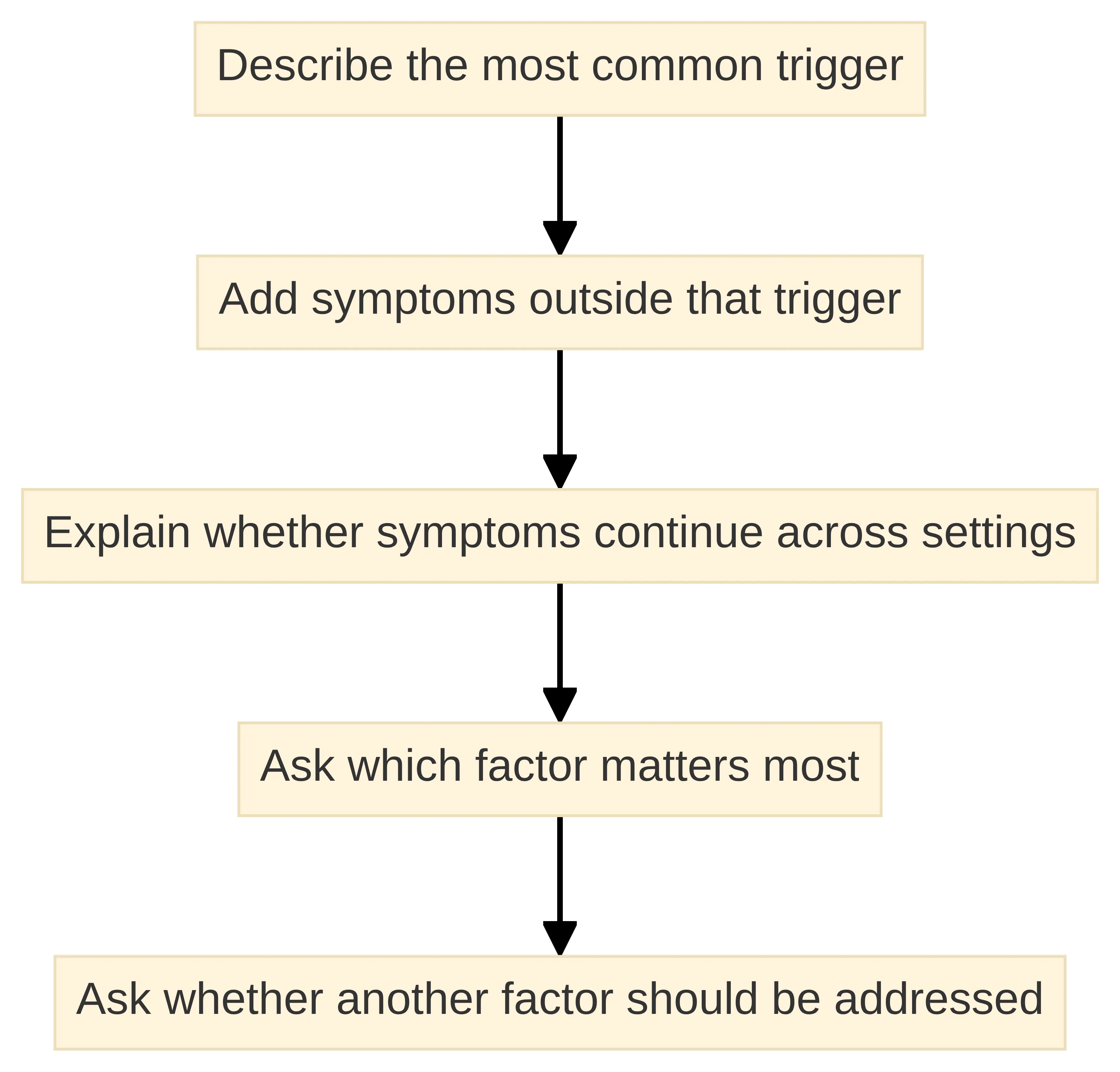
A multiple-contributor approach can organize your appointment:
- Describe the trigger that appears most often.
- Add symptoms that occur outside that trigger, including dryness, irritation, fluctuating vision, or contact-lens discomfort.
- Explain whether the symptom is limited to one setting or continues across settings.
- Ask which factor appears to matter most and whether another factor should be addressed at the same time.
This structure keeps you from treating a screen, a lens, wind, or dryness as the complete explanation before the evaluation is finished.
A pattern with several triggers or repeated episodes after you remove one suspected trigger is a reason to arrange an eye examination. Before that visit, avoid turning the list of settings into a list of presumed causes. Instead, group the observations by what they share: the same sensation, the same time of day, the same affected eye, or the same effect on an activity. Then identify the observations that do not fit the group. This gives the professional two useful kinds of information: a possible recurring pattern and the exceptions that may show why a single explanation is insufficient. It also creates a more focused discussion than asking which one trigger is “the” cause. You can ask which observations deserve the most weight, whether the patterns should be considered together, and what changes would make the next step different. The result is a clearer handoff from self-observation to professional evaluation without claiming that the groupings represent separate conditions. Persistent complexity is a reason to gather professional input, not a reason to keep guessing.
Let an examination answer what symptom tracking cannot
Symptom tracking can show when watering happens, but it cannot identify which contributing processes matter most. A useful consultation outcome is not necessarily a single label for every episode. It is a clearer understanding of which parts of the pattern need attention, whether more than one contributor may be relevant, and what next step fits the information available. That distinction matters because the same person may describe watering in several settings, while an eye-care professional still needs to determine which observations are most meaningful. Bring both the repeated features and the exceptions: a symptom that occurs after screen work, an episode that occurs outdoors, a change in contact-lens comfort, or watering that returns without an obvious exposure. Ask how those observations should be considered together rather than asking the professional to confirm the explanation you formed at home. Also ask what changes should be reported after the visit and what information would be useful if the pattern continues. The appointment is therefore a decision point for organizing uncertainty, not merely a search for a name. It can turn a scattered symptom history into a discussion about the factors that matter most and the appropriate follow-up. An eye-care evaluation considers the tear system as an interconnected whole and uses the pattern you describe to guide the assessment.
The examination conversation should help answer practical questions:
- Is the symptom more consistent with a surface-irritation pattern, a dry-eye pattern, or another contributor?
- Do the timing and environmental triggers matter to the assessment?
- Could contact-lens use or screen-related fatigue be part of the pattern without explaining everything?
- Does the inner-corner discomfort or visual change alter how promptly you should act?
- What should you do if the symptom persists or changes after the visit?
The point is not to make the appointment confirm a theory you formed at home. The point is to give the professional enough detail to evaluate the pattern and direct the next step.
A consultation can give you a structured place to discuss persistent, disruptive, or unexplained watering without assuming in advance that a particular procedure or treatment is appropriate.
We also offer private and secure telemedicine video visits for routine eye problems. A video visit can be an option for beginning a discussion about a routine concern, while sudden visual loss requires prompt medical assessment rather than a delay for convenience.
Prepare a short note for an eye-care consultation
Use a short consultation note to organize the next conversation: record the timeline of your tearing and the questions you want to discuss, including whether more than one contributor may be involved. Bring the note to an eye-care professional, and do not treat it as a diagnosis. A practical note can have three parts: a brief summary of when the watering began and how it has changed, a list of settings or activities connected with each episode, and the associated sensations or effects on daily life. Add anything that makes the pattern less clear, such as episodes without an obvious trigger, symptoms that occur in more than one setting, or uncertainty about which eye was affected. Then list the questions you want answered, including how the timing and associated symptoms should guide the evaluation and what changes should be reported afterward. Keep the language descriptive rather than diagnostic. “I notice watering after screen work and sometimes outdoors” gives the professional information to explore, while “I have a tear-drainage problem” assumes an explanation the examination has not established. This note is a communication aid: it helps you present the pattern consistently without promising what the evaluation will find.
We offer comprehensive eye examinations and advanced services, along with private and secure telemedicine video visits for routine eye problems. Bring your symptom timeline, triggers, contact-lens and screen details, and questions about whether more than one contributor may be involved. Only a qualified eye-care professional can determine what your symptoms mean and which next step fits your situation.
Questions about watery eyes and when to seek care
What are common causes of tearing eyes?
Tearing eyes can result from various factors, including dry eyes, environmental irritants, allergies, infections, and eyelid conditions. Each cause may present with different accompanying symptoms.
When should I seek professional evaluation for watery eyes?
You should arrange an eye examination if your watery eyes persist, disrupt daily activities, or are accompanied by symptoms like pain, swelling, redness, or changes in vision.
How can dry eyes lead to excessive tearing?
Dry eyes can sometimes cause excessive tearing, especially in response to environmental factors like wind or smoke. This occurs due to a mismatch in the tear system rather than a simple lack of moisture.
What information should I prepare for an eye examination regarding tearing eyes?
Before your appointment, note the duration and triggers of your symptoms, any associated sensations like irritation or pain, and how the symptoms affect your daily activities.