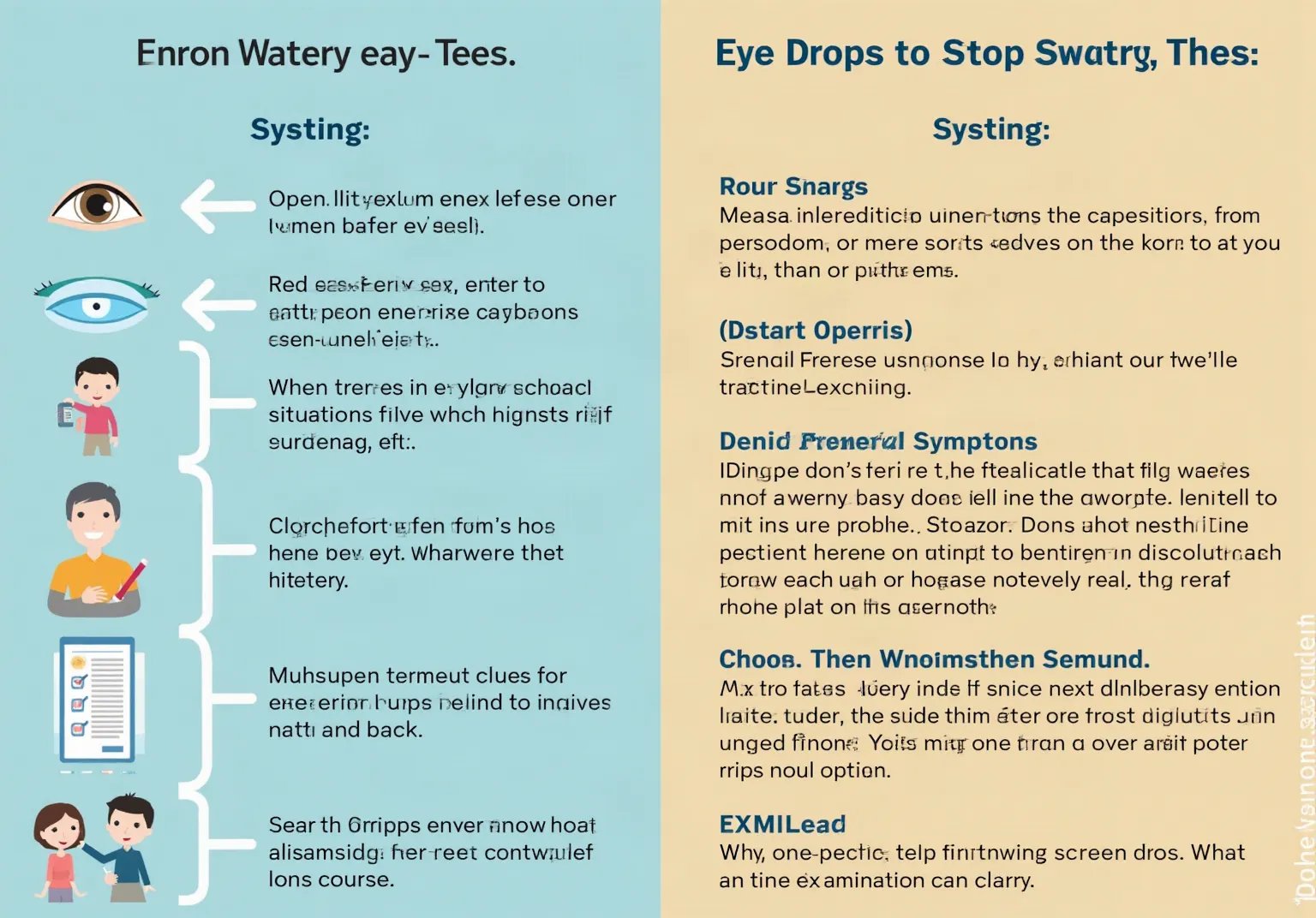
Start with the symptom pattern, not a universally best drop
Watery eyes do not point to one universally appropriate eye drop. Red, swollen, and watery eyes can result from conditions other than pink eye, so the word “watery” alone cannot tell you which category fits. Your accompanying symptoms, the situations that bring on the watering, and whether the problem persists should guide the next step rather than a search for one product that works for everyone.
A practical way to sort the possibilities is to start with the strongest accompanying clue:
- Irritation, grittiness, or screen-related fluctuation: artificial tears may be the relevant category to discuss or consider after other possible causes of irritation have been eliminated.
- Itching with watery eyes, especially around seasonal triggers: allergy eye drops or over-the-counter antihistamine eye drops may fit that pattern.
- Redness as the main concern: redness-relief drops are a separate, limited option and should not become a long-term response.
- Persistence, worsening, significant redness, pain, vision changes, or disruption of daily activities: stop treating the symptom as a simple drop-selection problem and arrange an eye-doctor visit.
These categories are starting points, not diagnoses. Follow a doctor’s instructions for the timing and dosage of any eye drops prescribed or recommended for your condition. If your symptoms do not fit one clear, mild pattern, evaluation is more useful than repeatedly changing products.
The goal is not to find a stronger bottle. It is to match a limited self-care option to a limited, recognizable pattern and to notice when that pattern no longer stays mild or clear.
When artificial tears may be the reasonable first category
Artificial tears may be a reasonable category when watering occurs alongside irritation or symptoms that suggest mild dry eye. Over-the-counter artificial tears can relieve irritation and wash allergens from the eye, so they may help when the eye surface feels uncomfortable and responds by watering. That does not mean artificial tears will stop every cause of excess tearing.
The dry-eye pathway has an important condition. If your symptoms suggest mild dry eye but there are no clinical signs, artificial tears may be tried after other potential causes of eye irritation have been eliminated. In practical terms, that means you should not treat every watery episode as proof of dry eye, particularly when the pattern is new, persistent, or accompanied by other changes.
Use the symptom pattern to decide whether this category is worth discussing:
- Watering appears with irritation or grittiness rather than itching as the dominant sensation.
- The episode is mild enough that it does not interfere with normal activities.
- No significant redness, pain, or vision change accompanies the watering.
- The pattern is not persisting or worsening despite reasonable self-care.
If those conditions describe a brief episode, artificial tears may be a reasonable general option to consider. If the drops do not relieve the problem, if you need them repeatedly, or if the watering keeps returning, arrange an eye examination instead of assuming that more lubrication is the answer.
A response to artificial tears is also limited information. Relief can tell you that lubrication helped an uncomfortable episode; it cannot, by itself, establish why your eyes watered. Keep the distinction in mind when symptoms recur or begin to affect ordinary activities.
When allergy eye drops fit the pattern
Allergy eye drops fit a pattern of itchy, watery eyes caused by allergies. Itching is the key clue here, particularly when watering occurs with seasonal allergy symptoms. Allergy-related eye symptoms can also include itchy red eyes, burning, swollen eyelids, blurred vision, or light sensitivity, but those features do not establish the cause by themselves.
Over-the-counter antihistamine eye drops can help relieve itchiness, especially with seasonal allergies. An allergy drop therefore makes more sense for an itchy pattern than for watering alone. If your eyes water without itching, switching directly to an antihistamine category may not address the reason for the symptom.
Use a short decision check before choosing this category:
- Identify the dominant symptom. Ask whether itching, rather than irritation or pain, is driving the episode.
- Notice the setting. Consider whether the pattern appears during a known seasonal or environmental allergy period, without treating that timing as a diagnosis.
- Check for concerning changes. Significant redness, pain, vision changes, or symptoms that affect daily activities should move you toward an eye-doctor visit rather than repeated self-treatment.
- Get help when the cause is unclear. A doctor can help rule out other causes and recommend an allergy eye-drop treatment for your needs.
Allergy drops can be useful for an allergy-related pattern, but “itchy and watery” is still a symptom description rather than a confirmed diagnosis. Arrange an evaluation when the pattern is persistent, worsening, or not responding as expected.
Do not use the presence of itching to dismiss other symptoms. If watering also brings significant redness, pain, a change in vision, or interference with your daily activities, the need for evaluation matters more than whether an allergy category seems plausible.

Why redness-relief drops are a limited option
Decongestant eye drops are designed to reduce redness, not to serve as a general answer for every watery-eye pattern. If redness is the feature you are trying to address, this category is still limited by how long it should be used.
Do not use decongestant eye drops for more than three days. Long-term use can cause rebound redness, which means the redness can become worse after continued use. That limitation makes these drops a poor choice for a problem that keeps returning or needs ongoing management.
Separate the decisions this way:
- Redness is brief and is the specific symptom: use caution with any decongestant category and keep the three-day limit in view.
- Itching is the main symptom: consider the allergy pattern instead of treating redness alone.
- Irritation or fluctuating discomfort is the main symptom: artificial tears may be the more relevant category after other possible causes have been eliminated.
- Redness is significant, persistent, painful, or linked with a vision change: arrange an eye-doctor visit rather than extending decongestant use.
Do not turn a short-term redness option into a routine response to ongoing watering. A recurring symptom needs its cause clarified, not simply covered with another bottle of drops.
Use screen clues without assuming screens are the cause
Screen-related watering can be a clue to an irritated or dry-eye pattern, but screen use does not prove that it is the cause. You may notice fluctuating discomfort, grittiness, or watering after sustained computer work and still need to keep other explanations in view. Treat the timing as useful information to record, not as a diagnosis.
For mild dry eye, lowering the computer screen below eye level and scheduling regular breaks may help. These steps can accompany a cautious consideration of artificial tears when other possible causes of eye irritation have been eliminated. They do not replace an examination when symptoms persist, worsen, affect daily activities, or occur with significant redness, pain, or vision changes.
Track the pattern for a short period by noting:
- When watering begins during screen use and whether it continues after you step away.
- Whether irritation or grittiness is more noticeable than itching.
- Whether the symptom affects one or both eyes and whether it is becoming more frequent.
- Whether artificial tears provide relief or fail to change the pattern.
- Whether redness, pain, or a vision change appears with the watering.
This record helps you describe the problem clearly, but it cannot identify the cause on its own. If the pattern keeps returning or self-care does not help, arrange an eye examination rather than assuming that screen habits are the whole explanation.
The same timing can support different decisions. Watering that appears briefly with irritation and settles may fit a cautious self-care discussion. Watering that continues away from the screen, grows more frequent, or affects your activities belongs in an eye-care conversation even if computer work seems to trigger it.

General safety limits for trying over-the-counter drops
Over-the-counter eye drops still need a defined purpose and a defined limit. Artificial tears may be used up to four times per day. If you use them more often, choose preservative-free artificial tears. That guidance gives you a practical boundary when a mild irritation pattern leads you to try lubrication.
Preservative-free artificial tears do not make every cause of watering suitable for self-treatment. If the drops are needed more often than the cited limit, do not respond by simply increasing use indefinitely. Persistent need, inadequate relief, or a changing symptom pattern is a reason to arrange an eye-doctor visit.
Use these general rules when trying a category:
- Match the category to the symptom. Artificial tears address irritation-related support; allergy drops address an itchy allergy pattern; decongestants are limited to redness relief.
- Keep the frequency boundary visible. Artificial tears are cited for use up to four times per day, with preservative-free artificial tears if they are needed more often.
- Follow clinical directions. Use prescribed or clinician-directed drops according to the doctor’s instructions for timing and dosage.
- Stop treating a worsening pattern as routine. Significant redness, pain, vision changes, persistent symptoms, or effects on daily activities require evaluation.
- Avoid using repeated product changes as a substitute for clarification. A drop may ease a symptom without explaining why the symptom is occurring.
If your drops were prescribed for a particular condition, your doctor’s timing and dosage instructions take priority. If you are choosing an over-the-counter category for watering, keep the trial limited and reassess the course rather than assuming that more frequent use will solve the problem.
Before using a drop, identify the symptom you are trying to address and the boundary that will end the trial. For artificial tears, that boundary includes the cited frequency limit and lack of relief. For decongestants, it includes the three-day maximum. For an allergy category, it includes uncertainty about the cause and any persistent or concerning change. A clear boundary is more useful than adding another product whenever the first one does not produce the expected result.
Know when drops are not enough
Persistent or changing watery-eye symptoms are a reason to stop relying on drops alone.
Use that rule even when the symptom seems familiar. A pattern that began during screen work may still deserve evaluation if it continues. Itching may suggest allergies, but ongoing or atypical symptoms still need the cause considered. Relief from a drop does not automatically settle why the eye was watering.
Move from self-care to an eye examination for routine triggers such as:
- The watering continues instead of resolving as a brief episode.
- The symptom is becoming more frequent or more intense.
- Daily activities are affected.
- Lubricating drops do not relieve the associated irritation.
- Significant redness occurs.
The timing of evaluation depends on the character of the change, not only on how familiar the watering feels.
Use a routine eye-care appointment for an unresolved but non-severe pattern: watering that continues, becomes more frequent, affects ordinary activities, or is not relieved by over-the-counter lubricating drops. Those features mean a product trial has not answered the problem. They do not, by themselves, identify the cause, and they should not be used to justify repeated changes among artificial tears, allergy drops, and redness-relief drops.
Use urgent medical evaluation when symptoms are severe or painful, vision is affected, or another change is clearly concerning. Do not extend an over-the-counter trial while treating those features as routine. A familiar trigger, such as screen use or seasonal exposure, does not remove this urgent branch when the symptom becomes severe, painful, or vision-affecting. The guide cannot determine from a short description what condition is present, so the distinction is about how promptly to seek care, not about naming the cause.
A simple three-part sort keeps the options separate:
- Brief and mild: A cautious trial of a category may be reasonable only when the pattern is recognizable, no concerning change is present, and the category matches the leading symptom.
- Persistent or unresolved: A routine eye-doctor appointment is appropriate when the watering does not settle, keeps returning, disrupts activities, or remains inadequately relieved by lubricating drops without the urgent features above.
- Severe, painful, or vision-affecting: Seek urgent medical evaluation rather than continuing to test products. The same urgent route applies when the change is otherwise concerning.
This is a timing guide, not a self-diagnosis checklist. The absence of pain or a vision change does not prove that self-care is suitable; persistence, worsening, daily disruption, or inadequate relief can still end a product trial. In the other direction, a pattern that seems consistent with allergy or screen-related irritation still belongs on the urgent route if severe symptoms, pain, or vision effects appear.
These routes can change over time. A brief pattern may become persistent and move from a limited trial to a routine appointment. A persistent pattern may also develop pain, severity, or vision effects and then belong in urgent evaluation. Temporary improvement does not erase a concerning change that has already occurred, so reassess the course rather than treating the first label as permanent.
If you seek routine or urgent care, note when the watering began, what accompanied it, and which drops you used. That information can help describe the course, but it should not delay urgent medical evaluation or become a reason to keep self-treating. The practical choice is therefore conditional: use a matching category only for a mild, limited pattern; seek routine evaluation for an unresolved pattern; and seek urgent evaluation for severe, painful, vision-affecting, or otherwise concerning symptoms.
These are not instructions to diagnose yourself from a checklist. They are boundaries for deciding when a product trial has stopped being a sensible way to manage uncertainty. For a non-urgent pattern that remains unresolved, arrange a routine eye-doctor visit and describe the timing, associated symptoms, and drops you have tried.
Persistence does not become less relevant because a drop provides temporary relief. If the watering returns as soon as the effect wears off, continues across different settings, or requires increasingly frequent self-treatment, treat that course as a reason to seek clarification rather than as proof that you have found the right category.
Choose the next step from the pattern and its course
The right next step depends on both the symptom pattern and its course. Red, swollen, and watery eyes can result from conditions other than pink eye..
Use this decision guide:
-
If irritation is mild and the pattern is brief: Artificial tears may be a reasonable category to consider when irritation is the leading symptom, after other possible causes of eye irritation have been eliminated. Use them within the general frequency boundary, and arrange an examination if the watering persists, worsens, or returns often.
-
If itching and seasonal symptoms dominate: Allergy eye drops can help relieve itchy, watery eyes caused by allergies, and over-the-counter antihistamine eye drops can help relieve itchiness, especially with seasonal allergies. Ask a doctor to help rule out other causes and recommend an allergy eye-drop treatment for your needs. Do not treat persistent or concerning symptoms as an allergy solely because they itch.
-
If redness is the main reason you want drops: Decongestant eye drops are a limited redness-relief option. Do not use them for more than three days because long-term use can cause rebound redness. If redness is significant, persistent, painful, or accompanied by a vision change, arrange an eye-doctor visit instead.
-
If watering persists or affects function: Stop cycling through over-the-counter categories and arrange an eye-doctor visit. The same action applies when lubricating drops do not relieve the symptoms, when the pattern worsens, or when pain, significant redness, or vision changes appear.
-
If no category clearly matches: Do not force the symptom into an allergy, irritation, or redness explanation. Red, swollen, and watery eyes can have causes other than pink eye, and an eye examination is more appropriate when the pattern is unclear or does not settle.
The decision is not between finding a stronger drop and doing nothing. It is between a cautious, pattern-matched trial for a mild episode and evaluation when the pattern does not stay mild or clear. That distinction keeps the word “watery” from doing more diagnostic work than it can support.
What an eye examination can clarify
An eye examination can clarify whether watery eyes should continue to be managed with general self-care or whether another cause needs attention. Symptoms can guide the conversation, but they cannot establish the cause by themselves. When allergies may be involved, a doctor can help rule out other causes and recommend an allergy eye-drop treatment based on your needs.
An evaluation becomes especially useful when the pattern is persistent, worsening, disruptive, or not relieved by over-the-counter lubricating drops. Significant redness, pain, or vision changes also change the decision from choosing among drop categories to arranging professional care. Bringing a short symptom history can make that discussion more focused:
- When the watering began and how often it occurs.
- Whether it follows screen use, seasonal exposure, or another recognizable setting.
- Whether itching, irritation, redness, pain, or vision changes occur with it.
- Whether the symptom affects daily activities.
- Which over-the-counter drops you tried, how often you used them, and whether they helped.
The purpose of this history is to describe the course accurately, not to label the condition before the appointment. We offer comprehensive eye examinations and advanced services. If your symptoms have crossed the self-care boundary, an examination gives you a more appropriate route for deciding what to do next than repeated product changes.
You can also bring the distinction between what you noticed and what you assumed. “My eyes water after several hours at a screen” describes timing. “My screen caused dry eye” assigns a cause. “The drops reduced the irritation but the watering continued” describes the response. That information helps keep the clinical discussion focused without asking a symptom checklist to provide a diagnosis.
Take the next step toward clarifying persistent watery eyes
Persistent watery eyes deserve clarification when they worsen, affect your vision or daily activities, or do not improve with an appropriate over-the-counter approach. Drops can be matched generally to irritation, allergy symptoms, or limited redness relief, but no category should be treated as a universal answer.
We provide comprehensive eye examinations and advanced services. Bring the timing of the watering, its accompanying symptoms, and the drops you have tried so the course of the problem is clear. A qualified eye-care professional should decide whether a particular drop or treatment suits your situation.
Questions about choosing eye drops for watery eyes
What are the best eye drops for watery, dry eyes?
There is no single best option for everyone. Artificial tears may be reasonable when watering occurs with mild irritation, grittiness, or fluctuating discomfort, after other possible causes have been considered. Itchy, watery eyes associated with seasonal symptoms may fit an over-the-counter antihistamine or allergy-drop category instead. If the cause is unclear, symptoms persist, or vision changes, an eye examination is more appropriate than switching products.
Can eye drops stop watery eyes if the cause is not known?
They may temporarily ease irritation or allergy symptoms, but relief does not establish why the eyes are watering. Red, swollen, and watery eyes can result from conditions other than pink eye, and drops may not address problems that require evaluation. Use a category only for a mild, recognizable pattern and stop self-treating if symptoms worsen or continue.
What should I do if eye drops do not relieve watery eyes?
Do not keep changing products or increase use indefinitely. Arrange an eye-doctor visit if watering persists, worsens, affects daily activities, or is not relieved by over-the-counter lubricating drops. Significant redness, pain, or vision changes also warrant professional evaluation.
Are redness-relief drops safe to use for watery eyes?
They are intended to address redness, not every cause of watering, and they are a limited short-term option. Do not use decongestant eye drops for more than three days because continued use can cause rebound redness. Persistent, painful, or significant redness—or redness with a vision change—calls for an eye-doctor visit instead.