
A visible eye growth needs examination, not a self-diagnosis
A visible eye growth deserves identification before you make decisions about monitoring or treatment. Pterygium is one possibility, but appearance alone cannot establish what a growth is or what should happen next. An eye doctor can evaluate a possible pterygium with a slit-lamp examination, and some growths that appear similar may require further examination under a microscope if they are removed.
Your first decision is therefore not whether to have surgery. Your first decision is whether the finding has been professionally identified and whether a change in vision, comfort, or appearance deserves clarification.
A practical approach is to separate three questions:
- What exactly is the growth?
- Has anything about its appearance, vision effects, or comfort impact changed?
- What does an eye-care professional recommend you monitor, and when should you return?
Those questions keep a visible finding from becoming a self-diagnosis. They also give you a useful way to prepare for an examination, whether the next discussion concerns professional monitoring, nonsurgical care, or surgery.
A possible pterygium should be treated as an observation that needs context, not as proof that surgery is necessary. If an eye-care professional has already examined the growth and given you a monitoring plan, follow that plan and note the changes you were told to report. If the growth is new, changing, uncertain, or associated with a meaningful change in vision or comfort, arrange an eye examination rather than choosing a treatment path from appearance alone.
The distinction matters because a photograph, mirror, or casual comparison cannot answer the same questions as an examination. Your goal is not to label the growth yourself. Your goal is to bring the right details to a qualified professional so the next decision is based on what was found.
If you are unsure how long the growth has been present, say so. If you do not know whether your vision change is connected to it, describe the timing without assigning a cause. Clear uncertainty is more useful than a confident conclusion based only on what you can see.
What pterygium is and where it develops
A pterygium is a triangular, fibrovascular growth that extends from the conjunctiva toward the cornea. In plain terms, the described growth begins on the conjunctival surface and extends in the direction of the cornea, the clear front part of the eye. The description identifies the shape, tissue character, and direction of extension; it does not tell you how a particular growth will affect your vision or what treatment you need.
Pterygium may appear nasally, temporally, or in both areas, with nasal growths described as more common. Those location terms help you describe what you see: nasal refers to the side closer to your nose, while temporal refers to the side closer to your temple. Location can make your description more precise, but it does not replace an examination.
A growth that resembles pterygium should not be named from appearance alone. Some precancerous growths can look similar to pinguecula or pterygium, which is one reason an eye-care professional may need to assess the finding directly.
A description of the visible change can make an appointment more useful. Record the following without trying to decide what the growth is:
- Which eye is affected, or whether both eyes have a visible change.
- Whether the change is on the side nearer your nose, the side nearer your temple, or both.
- When you first noticed it.
- Whether its size, shape, or visible area seems different from an earlier point.
- Whether your vision or comfort feels different when the change is noticeable.
- Whether the change appears in particular settings, such as after outdoor time, although that pattern does not establish a cause.
A personal description is a starting point, not a diagnosis. If you are unsure whether the appearance has changed, say that directly. Uncertainty is useful information for the professional assessing the eye.
What ultraviolet exposure can—and cannot—explain
Ultraviolet exposure is identified as the most important risk factor for pterygium in the cited ophthalmology material, while the underlying biology is not fully understood. The same material describes ultraviolet exposure as causing cellular and molecular damage associated with pterygium development and says ultraviolet-B can induce cytokine and growth-factor expression in pterygial tissue.
That information gives you context, not a personal explanation. Ultraviolet exposure cannot establish that a visible growth is pterygium, determine how advanced it is, or tell you whether observation, nonsurgical care, or surgery belongs in your situation. It also cannot show whether a particular change in vision or comfort comes from the growth.
A risk factor is not a diagnosis. You can have a history that includes substantial outdoor exposure and still need an examination to identify the growth. You can also be uncertain about your exposure history and still deserve a clear evaluation if the appearance or visual experience has changed.
Ultraviolet history is worth mentioning during an eye-care appointment because it adds context to the discussion. You can note outdoor work, recreation, or other repeated exposure in general terms, but avoid turning that history into a conclusion about the growth.
The useful question is not, “Did ultraviolet exposure cause this?” The useful questions are, “What does the examination show?” and “What should I watch for from here?” Those questions move the conversation from a possible contributor to the finding that actually needs professional interpretation.
If you are deciding whether to monitor or arrange an examination, let the current uncertainty guide you. Exposure history may be part of the background; it is not a substitute for direct assessment. You do not need to prove an exposure pattern before asking for an examination.
Use changes in appearance, vision, and comfort to decide whether to seek clarification
Changes in appearance, vision, and comfort are useful details to record, but none of those observations can identify the growth by itself. Use them to decide what to discuss, not to assign yourself a diagnosis.
Start with appearance. Ask whether the visible area looks larger, extends farther toward the cornea, or appears different from an earlier point. You do not need to measure it precisely. A dated note or photograph taken for your own comparison may help you describe a change, but it should not be used to decide that surgery is needed.
Next, describe vision in concrete terms. Note whether you are noticing a new or changing blur, a difference in how clearly you see, or a visual change that appears alongside the growth. Avoid assuming that the growth caused the change. The timing is still worth reporting.
Finally, describe comfort. Note whether the eye feels different when the visible change is more noticeable, and whether the effect is occasional, persistent, or becoming more intrusive. A comfort complaint can help shape the appointment conversation without proving its source.
A short observation log can keep the discussion focused. Write down the date, what you noticed, which eye was involved, and whether the change concerned appearance, vision, comfort, or more than one of these. Add what you were doing when you noticed it if that detail seems relevant to the pattern.
Keep the wording descriptive rather than diagnostic. “The visible area looked different in the right eye” is more useful than deciding that the growth has progressed. “Blur was present while reading” records an experience without claiming that the growth caused it.
Bring the log to the appointment or use it to explain the pattern over time. A brief record cannot replace examination, but it can help you give a more accurate account than memory alone.
A new, changing, or uncertain eye growth is a reasonable reason to arrange an eye-care appointment because an eye doctor can evaluate a possible pterygium with a slit-lamp examination. If you believe a change needs urgent attention, seek urgent professional evaluation.
If an examination has already established what you are monitoring, follow the specific return instructions you were given. If no professional has assessed the growth, or if the situation no longer resembles the one you discussed, arrange clarification rather than assuming the original plan still applies.
An eye examination can clarify what monitoring alone cannot
An eye doctor can evaluate pterygium with a slit-lamp examination. That direct examination gives you a way to discuss the finding as an observed eye condition rather than relying on a mirror image or a description from memory.
An examination can help organize the questions that monitoring alone cannot answer: what the growth appears to be, where it is located, whether the professional sees a reason for additional assessment, and which changes should prompt you to return. The examination is a clarification step. It is not an automatic commitment to surgery.
Bring your timeline and your observations to the appointment. Tell the professional when you first noticed the change, whether it looks different now, and what you notice about vision or comfort. If you have an earlier evaluation, bring the instructions you received so the discussion can focus on what has changed and what has remained the same.
Prepare for the examination by separating what you know from what you suspect. You know when you noticed the visible change, what you can see now, and what you feel or notice while using your eyes. You may suspect that the growth explains a visual or comfort change, but that connection still needs professional interpretation.
Useful details to bring include:
- The date or approximate period when you first noticed the growth.
- Any change in appearance that you can describe over time.
- A timeline for changes in vision or comfort.
- Outdoor exposure or other background information you think may be relevant.
- Any previous examination instructions about monitoring or follow-up.
Ask what the examination established, what remains uncertain, and what change should lead you to contact the practice again. These questions turn a general appointment into a clearer discussion about your next step.
How clinicians may frame monitoring, nonsurgical care, or surgery
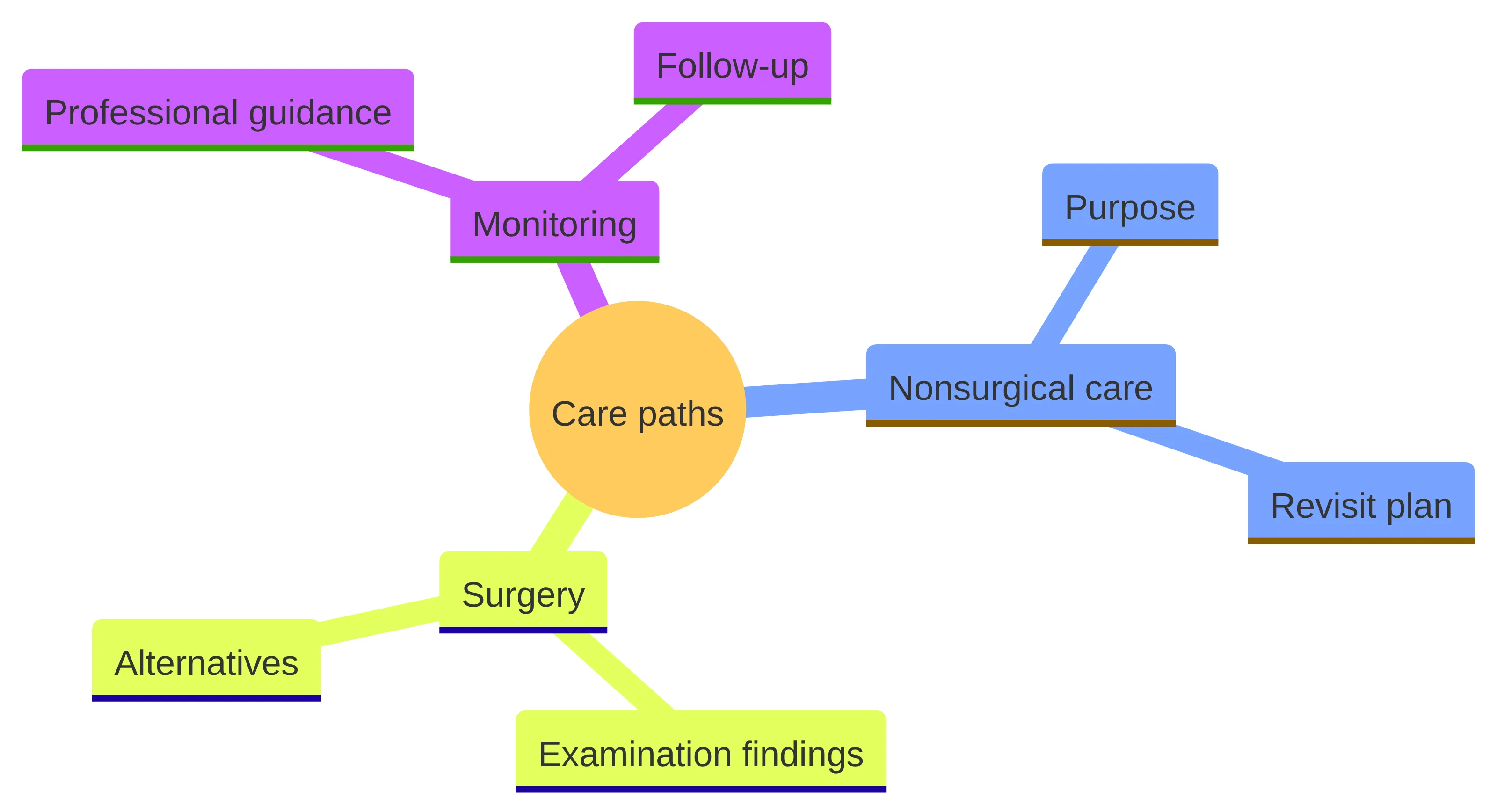
Monitoring, nonsurgical care, and surgery are discussion paths, not choices you can assign to yourself from a visible photograph. The relevant path depends on what the professional identifies and how the finding relates to your vision, comfort, and changes over time.
Monitoring with professional guidance means you understand what is being watched, what change matters, and when follow-up should occur. Ask for those details rather than accepting “keep an eye on it” as a complete plan. A useful monitoring plan should give you a clear reason to contact the practice sooner.
Nonsurgical care should be explained in terms of its purpose. Ask what concern it addresses, how you should use it if it is recommended, and what would show that the plan needs to be revisited. Do not begin a treatment regimen from a general article or assume that a comfort measure identifies the cause of the growth.
Surgery should be discussed as a response to the findings of an examination and the concerns you bring to the appointment, not as the default response to visibility. Ask what problem the procedure is intended to address, what alternatives belong in the conversation, and what you should weigh before deciding.
You can make the three-path discussion more concrete by asking the same questions about each option:
- What finding makes this path relevant to my situation?
- What is this option intended to address?
- What would monitoring look like if I did not proceed with another form of care?
- What change would lead to a new discussion?
- What information do you need from me before making a recommendation?
These questions do not turn general information into a treatment plan. They help you understand why a professional is discussing a particular path and what remains undecided. If the examination does not establish that a visible growth is pterygium, keep the conversation focused on identification before comparing treatments.
Antimetabolite use in eye surgery deserves a specific discussion if it is mentioned as part of a surgical plan. The cited Cochrane material says antimetabolite use in eye surgery should be approached cautiously because serious complications have been reported, and that the minimum topical amount should be used when such treatment is used in light of previous vision-threatening complications.
That caution is not a personal recommendation about whether you should have surgery or whether a particular medication belongs in your care. It is a reason to ask precise questions: Is an antimetabolite being considered? What purpose would it serve in the proposed plan? What risks and alternatives should you understand? The clinician who examines you must explain how, or whether, that general safety concern applies to your situation.
Questions to ask before discussing pterygium surgery
A surgery discussion becomes more useful when you ask what the examination found before asking what procedure to choose. Take the following questions with you and select the ones that match your concerns. You do not need to ask every question in one visit; begin with the points that affect your immediate decision.
- What is the growth most consistent with, and how certain is that assessment?
- What did the slit-lamp examination show about its location and appearance?
- Is anything about the finding affecting my vision or comfort, or is that still uncertain?
- What changes should make me contact you sooner than the planned follow-up?
- What would monitoring involve, and when should the finding be reassessed?
- If nonsurgical care is discussed, what concern is it intended to address?
- What specific examination finding makes surgery worth discussing in my case?
- What is the intended purpose of surgery, and what alternatives should I compare with it?
- What information about my eye history would change the discussion?
- If tissue is removed, would it be examined under a microscope, and why would that matter here?
- What should I understand before deciding whether to continue monitoring or discuss another path?
These questions do not determine whether you are eligible for surgery. They help you understand the reason for a proposed path and the boundary between general information and a recommendation made after examining your eye.
If an antimetabolite is being considered, ask why it is part of the plan, what purpose it would serve, what alternatives should be discussed, and how the reported serious complications affect the decision. The cited Cochrane material says this type of use in eye surgery should be approached cautiously and that the minimum topical amount should be used when it is used. Your examining clinician must connect that general information to the proposed plan, if one is being discussed.
Choose a professionally guided next step for a changing or uncertain growth
A changing or uncertain eye growth calls for clarification before you decide what to do about it. If an eye-care professional has already identified the finding and given you a monitoring plan, use that plan and record the changes you were told to report. If the growth has not been examined, or if your appearance, vision, or comfort has changed, arrange an eye examination and bring a clear timeline of what you noticed.
The central boundary is simple: ultraviolet exposure may provide context, and a visible growth may resemble pterygium, but neither establishes your diagnosis or determines your treatment. A slit-lamp examination can help clarify the finding, while any discussion of nonsurgical care or surgery should be connected to what the professional sees and to the concerns you describe.
Only a qualified eye-care professional can decide what the finding means for you and whether any treatment is suitable. DLV Vision provides care for corneal conditions such as pterygium.
Questions readers may have about eye pterygium and evaluation
What is pterygium and where does it develop on the eye?
Pterygium is a triangular, fibrovascular growth that extends from the conjunctiva toward the cornea. It typically appears nasally or temporally, with nasal growths being more common.
When should I seek an eye examination for pterygium?
You should arrange an eye examination for a new, changing, or uncertain growth. An eye doctor can evaluate a possible pterygium with a slit-lamp examination.
How is pterygium diagnosed?
An eye doctor can diagnose pterygium through a slit-lamp examination.
What factors influence the decision between monitoring and surgery for pterygium?
The decision depends on the growth’s characteristics, any changes in vision or comfort, and the recommendations from an eye-care professional.
What should I discuss with my eye doctor regarding pterygium treatment?
You should ask about the nature of the growth, any necessary follow-up, potential nonsurgical care options, and the indications for surgery.