Start With the Pattern, Not a Diagnosis
Eyes watering is a symptom, not a diagnosis. Dry eye can be associated with excess tearing, while pink eye can include tearing along with redness, swelling, discharge, itching, or discomfort. Those patterns can overlap, and symptoms can vary by cause, so watering alone cannot tell you what is happening.
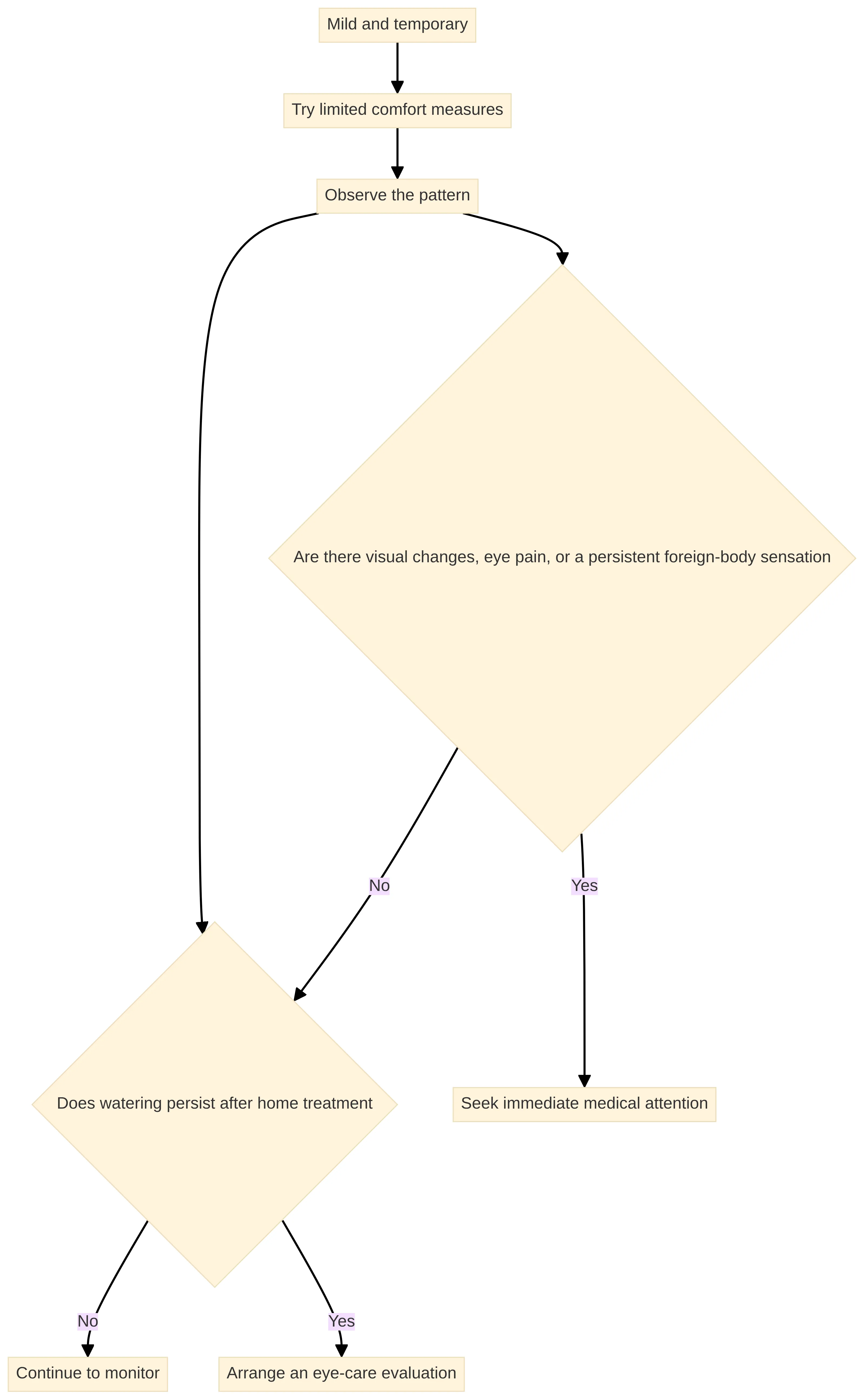
Your next step depends on what accompanies the watering and how long it lasts. Mild watering that settles may justify a short period of general comfort measures. Watering that persists after home treatment calls for an eye-care evaluation. Watering with reduced vision or other visual changes, pain around the eyes, or a persistent foreign-body sensation calls for immediate medical attention.
Use this three-part guide to choose a direction:
- Monitor briefly: Choose this route when watering is mild, temporary, and not accompanied by the warning signs described below. Use only general comfort measures and pay attention to whether the pattern settles.
- Arrange an evaluation: Choose this route when watering persists after home treatment, keeps returning, or comes with symptoms that make ordinary activities difficult. – Seek immediate care: Choose this route when watering occurs with reduced vision or visual changes, pain around the eyes, or a persistent foreign-body sensation.
Why Irritation and Dryness Can Both End in Watering
Dry eye can cause both burning and watering. That combination can feel contradictory, particularly when your eyes seem full of tears but also feel gritty, irritated, or tired. The presence of tears does not by itself establish that the eyes are adequately comfortable or identify the reason for the watering.
The American Academy of Ophthalmology lists burning, blurred vision while reading, a gritty sensation, mucus, redness or irritation, painful contact-lens wear, and lots of tears among symptoms associated with ojo seco. You may notice only one of these signs, or several at the same time. The pattern is useful to describe during an evaluation, but it is not a diagnosis.
A dry-eye flare-up may be temporary and last from a few days to a few weeks. That time frame gives you a practical observation point: note whether watering settles, continues, or returns after a brief episode. A longer or repeated pattern deserves more attention than an isolated episode that resolves.
Age can raise the risk of several eye conditions, including dry eye, and DLV Vision’s public guidance explains that exámenes oculares completos can help detect these conditions early. You do not need to decide that age or dry eye explains your symptoms before arranging an evaluation. Record the pattern and let an eye-care professional assess it.
Do not treat the few-days-to-few-weeks description as a waiting rule for every episode of watering. It describes a possible dry-eye flare-up, not a diagnosis or a promise that symptoms will resolve on their own. If a warning sign appears, the duration does not lower the need for immediate care. Without warning signs, persistence after home treatment or repeated episodes are more useful reasons to arrange an evaluation.
An absence of dramatic pain should not be the only reason to dismiss an ongoing change. DLV Vision’s public guidance also notes that most age-related eye diseases develop slowly and without pain, and many people may not notice symptoms until vision is affected. This does not mean watering indicates an age-related disease; it means that persistence or recurrence remains worth discussing even when discomfort is limited.
When watering appears with irritation, notice the details that travel with it:
- Burning or stinging
- A gritty or scratchy feeling
- Redness or irritation, especially in particular environments
- Mucus around the eyes
- Blurred vision while reading
- Pain or discomfort while wearing contact lenses
- Episodes that last days, return after settling, or become more frequent
These observations help you describe the problem clearly. They do not establish that dry eye is the cause, because the same broad symptom can occur in more than one eye condition.
Use Screen and Contact-Lens Patterns as Clues, Not Conclusions
Screen-related watering is a pattern to observe, not a conclusion to make. Prolonged use of computer screens, televisions, and smartphones can cause dry eye and fatigue. The American Academy of Ophthalmology recommends giving your eyes occasional breaks by looking away from the screen and focusing on something in the distance.
Ask yourself when the watering appears: after a long work session, late in the day, while reading, or in a room with noticeable glare? A timing pattern can help you explain the symptom at a visit. It cannot show that screen use is the only cause, and it should not delay care when visual changes, pain, or a persistent foreign-body sensation are present.
For screen-related discomfort, try a few concrete adjustments during a brief observation period:
- Look up from the screen periodically and focus on something in the distance.
- Sit about 25 inches, or an arm’s length, from the screen.
- Position the screen so you look slightly downward at it.
- Reduce glare and adjust brightness and contrast if they contribute to eye strain.
- Consider artificial tears to lubricate the eyes.
Use these as general comfort measures, not as a way to identify the cause of watering. If the symptom continues after home treatment, move from observation to an eye-care evaluation.
Contact-lens wear can add a second pattern to track. Contact lenses can increase dryness and irritation, and wearing eyeglasses instead during long computer sessions may reduce those symptoms. Contact lenses can also be associated with blurred or fluctuating vision, especially when dry eyes or allergies are present; that fluctuation may be worse at the end of the day as the eyes dry out and become tired.
Write down whether watering occurs during lens wear, after removal, during screen work, or near the end of the day. As contact-lens wearers age, dry eye may make lenses more difficult or impossible to wear. These observations support a useful conversation, but they do not prove that the lenses are responsible.
Notice When Redness, Discharge, or Itching Changes the Picture
Pink eye can include redness, swelling, tearing, discharge, itching, or discomfort, although symptoms vary by cause. Dry eye may also involve redness, irritation, mucus, and excess tearing. That overlap is why the appearance of your eye should be described rather than used as a self-diagnosis.
Notice whether the watering comes with visible redness, swelling, mucus or discharge, itching, burning, grittiness, or discomfort. Note whether the change affects one eye or both, and whether it began after a particular exposure or activity. A symptom record gives an eye-care professional more useful information than the label you may have assigned to it.
Redness or discharge changes the reason to seek advice when it is paired with more concerning symptoms. Reduced vision or visual changes, pain around the eyes, or a persistent foreign-body sensation with watery eyes warrant immediate medical attention.
Do not wait for a home comfort routine to answer an urgent question. Use the symptom pattern and its severity to choose the appropriate level of care.
A useful description separates what you observed from what you suspect. You might record, for example, that your eyes watered with redness and itching, or that watering came with mucus and blurred reading vision. Avoid deciding that these signs confirm pink eye or dry eye before an examination. Symptoms vary depending on the cause, and an eye-care professional can assess the full pattern.
Try a Short, Low-Risk Comfort Check
A short comfort check is appropriate only for mild or temporary watering without urgent warning signs. Its purpose is to give you a structured way to observe whether simple changes affect the symptom. It is not a test that confirms dry eye, screen strain, contact-lens intolerance, or any other condition.
Use the measures that match your day:
- Give your eyes occasional breaks by looking away from the screen and focusing on a distant object.
- Keep the screen about 25 inches, or an arm’s length, away and slightly below eye level.
- Reduce glare and adjust screen brightness or contrast if they contribute to eye strain.
- Use artificial tears to lubricate the eyes.
- During long computer sessions, consider wearing eyeglasses instead of contact lenses if lens wear is associated with dryness or irritation.
Match each comfort measure to the circumstance you are observing so the record remains interpretable. Screen breaks, viewing distance, screen position, and glare adjustments are measures for the screen context; artificial tears may lubricate the eyes; and wearing eyeglasses instead of contact lenses during long computer work may reduce lens-related dryness or irritation. A change after one measure may show that the symptom changes in that context, but it cannot establish a medical cause. If watering occurs outside that context or remains after the change, do not keep expanding the home routine; use the evaluation route.
Record what you changed and what happened afterward. Note whether watering was less noticeable during screen breaks, whether artificial tears changed the sensation, and whether symptoms appeared during contact-lens wear or a long computer session. Keep the record factual: describe the change without treating it as proof of a particular cause.
A comfort check should remain brief and limited. If watering persists after home treatment, arrange an eye-care evaluation rather than extending self-management indefinitely. If reduced vision or visual changes, pain around the eyes, or a persistent foreign-body sensation appears, seek immediate medical attention instead.
Stop the comfort check and choose professional care when the symptom does not settle, changes noticeably, or interferes with ordinary activities.
Choose Monitoring, Evaluation, or Immediate Care
Monitoring fits a mild, temporary pattern without concerning changes. If watering improves after a short period of general comfort measures, continue to observe whether it returns and record the circumstances. Looking away from screens, adjusting the screen position, reducing glare, and using artificial tears are supported general measures for screen-related discomfort.
Monitoring does not mean ignoring a recurring problem. If the symptom persists after home treatment, move to an eye-care evaluation even if the watering is not severe.
An eye-care evaluation fits watering that persists after home treatment, returns often, or comes with a pattern you cannot explain. Persistent symptoms deserve assessment because an examination can help determine the cause, while comprehensive eye exams can help detect several eye conditions early.
Arrange an evaluation and bring a short symptom record. Include when the watering began, how often it appears, what symptoms accompany it, whether screen use or contact lenses affect the pattern, and which comfort measures you tried. Persistence is not a fixed calendar cutoff. A symptom can deserve discussion because it keeps returning or interferes with work, reading, or lens wear, even if each episode settles. Conversely, a recent symptom with reduced vision, visual changes, pain around the eyes, or a persistent foreign-body sensation requires immediate care rather than waiting to see whether it lasts. Duration helps describe the pattern, but it does not override warning signs.
Immediate medical attention fits watery eyes accompanied by reduced vision or visual changes, pain around the eyes, or a persistent foreign-body sensation. These signs change the decision from watching the symptom to seeking care without waiting for a routine comfort check.
Tell the clinician exactly what changed and when it began.
The decision can be reduced to three actions:
- Mild and temporary: try limited comfort measures and observe the pattern.
- Persistent after home treatment: arrange an eye-care evaluation.
- Visual change, eye pain, persistent foreign-body sensation, or possible keratitis symptoms: seek immediate or right-away professional care, with extra urgency for contact-lens wearers.
The purpose of this framework is to choose an action, not to name a condition.
Treat Contact-Lens Warning Symptoms With Extra Urgency
Contact-lens wearers should track the details that distinguish a recurring comfort problem from a more concerning change:
- Whether watering starts during lens wear or after lenses are removed
- Whether contact-lens wear becomes painful or uncomfortable
- Whether vision becomes blurred or fluctuates
- Whether the pattern is worse late in the day
- Whether dry, irritated eyes make lenses difficult to wear
Painful contact-lens wear, blurred or fluctuating vision, and excess tearing can occur in dry-eye patterns, but those symptoms alone do not identify the cause. Include them in your description and seek prompt advice when the change is significant.
Long computer sessions can add to contact-lens discomfort. The American Academy of Ophthalmology notes that contact lenses can increase dryness and irritation and suggests wearing eyeglasses instead during longer computer work to reduce those symptoms. You can use that general measure while arranging appropriate care, but do not use it to explain away visual changes, pain, or a persistent foreign-body sensation.
Prepare a Useful Symptom Record Before the Visit
A symptom record turns watery eyes into a clear timeline you can discuss during an eye-care visit. Start with the first noticeable episode and write down what happens before, during, and after the watering. Keep observations separate from conclusions.
Include these details:
- When the watering began and whether it has persisted, settled, or returned
- Whether one eye or both eyes are affected
- How often the episodes occur and how long they last
- Whether screen use, reading, outdoor conditions, or contact-lens wear appear around the episodes
- Burning, stinging, grittiness, mucus, redness, itching, swelling, or discomfort
- Blurred reading vision or other visual changes
- Pain around the eyes or a persistent foreign-body sensation
- Which general comfort measures you tried and what changed afterward
Contact-lens details deserve their own line. Record the type of correction you were using, when you put the lenses in, when discomfort or watering began, whether vision fluctuated, and whether the pattern was worse near the end of the day. Contact lenses can be associated with blurred or fluctuating vision, especially when dry eyes or allergies are present.
To make the timeline more useful, distinguish a symptom that occurs only while lenses are in place from one that remains after removal. Record whether the change was gradual or sudden, whether one or both eyes were involved, and whether the watering was accompanied by pain, visual changes, redness, mucus, itching, or a persistent foreign-body sensation. Do not use the timeline to decide that contact lenses caused the symptom. Its purpose is to give the eye-care professional a sequence to assess.
Also record what happened when you stopped a routine activity or changed your correction, without extending a home trial when warning signs are present. For example, note whether watering appeared during a long computer session, after reading, or independently of screen use. Include when artificial tears or a screen break were used and whether the sensation changed. A response can be relevant history even when it does not explain the cause.
If the pattern keeps returning, include the interval between episodes and whether it is becoming more frequent or interfering with work, reading, or lens wear. If you cannot identify a trigger, write that down as well. A complete record includes uncertainty; it does not require a diagnosis. Bring the record even if the episode has settled, because the timing and accompanying symptoms can help frame the discussion.
If long screen sessions are part of your routine, note the approximate timing and whether breaks, screen adjustments, artificial tears, or eyeglasses changed the symptoms. These details describe your experience without assuming that the screen or lenses caused it.
Bring direct questions to the visit:
- What patterns in my symptoms need attention first?
- Could the combination of watering and irritation have more than one possible explanation?
- Which changes should prompt immediate contact rather than routine follow-up?
- How should I describe my contact-lens and screen-use pattern?
- What type of eye-care evaluation is appropriate for the symptoms I have recorded?
An examination can help determine the cause, and comprehensive eye exams can help detect several eye conditions early. Your record gives the clinician a precise starting point. Also record the warning signs you did not notice, rather than leaving them ambiguous. For example, state whether you observed any visual change, pain around the eyes, or persistent foreign-body sensation. This does not rule out a condition, but it makes the urgency discussion more precise and helps the clinician understand why you chose monitoring or evaluation.
What an Eye-Care Evaluation Can Clarify
An eye-care evaluation can help clarify what your symptom pattern represents. The examining professional can consider the combination of watering, irritation, discharge, visual changes, contact-lens use, screen exposure, and how long the problem has lasted. A comprehensive eye exam can also help detect several age-related eye conditions early.
The value of an evaluation is the shift from guessing based on a single symptom to discussing the full pattern. Bring your record, describe the changes in your own words, and mention any warning signs that occurred even if they have since settled.
At DLV Vision, we offer comprehensive eye examinations and advanced services. That stated offering gives you a path to discuss persistent or troublesome watering with an eye-care team rather than relying only on self-observation.
DLV Vision also offers private, secure telemedicine video visits for routine eye problems, cataract evaluations, and LASIK consultations. Whether a video visit is appropriate for your particular watery-eye symptoms is a question for the practice’s clinical team; urgent warning signs should follow the immediate-care pathway rather than wait for a routine format.
Prepare for an evaluation by bringing your symptom timeline and a concise description of what you want clarified. Mention whether the watering persists after home treatment, whether it interferes with work or reading, and whether contact lenses or screens appear in the pattern. Include reduced vision or visual changes, pain around the eyes, or a persistent foreign-body sensation immediately when arranging care.
A clear account does not need a diagnosis attached to it. It needs timing, accompanying symptoms, changes you tried, and the reason you want the pattern assessed.
Take the Next Step Toward Evaluating Persistent Watery Eyes
Persistent watery eyes deserve a decision based on the pattern: use limited comfort measures for mild, temporary symptoms, arrange an eye-care evaluation when watering persists after home treatment, and seek immediate medical attention for visual changes, eye pain, or a persistent foreign-body sensation. Contact-lens wearers should contact an ophthalmologist right away if they notice symptoms of keratitis.
We offer comprehensive eye examinations and advanced services, along with private, secure telemedicine video visits for routine eye problems, cataract evaluations, and LASIK consultations. A qualified eye-care professional who examines you must decide what applies to your eyes and which evaluation approach is appropriate. Use your symptom record to make that next conversation specific.
A clear timeline, the symptoms that accompany watering, and the urgency signs you noticed can help you choose the appropriate next step.
Questions About Watery Eyes and When to Seek Care
When should I seek professional evaluation for watery eyes?
You should seek professional evaluation if your watery eyes are accompanied by reduced vision, pain around the eyes, a persistent foreign-body sensation, or if the symptoms do not improve after home treatment.
What self-care measures can help with mild watery eyes?
For mild watery eyes, you can try using artificial tears to lubricate your eyes, taking breaks from screens, reducing glare, and ensuring you are sitting at an appropriate distance from your screen.
How can I prepare for an eye-care visit regarding watery eyes?
Prepare for your eye-care visit by keeping a symptom record that includes when the watering began, how often it occurs, any accompanying symptoms, and what self-care measures you have tried.
What should I do if my watery eyes are related to contact lens use?
If your watery eyes are related to contact lens use, consider wearing eyeglasses instead during long sessions, and track whether the symptoms worsen during lens wear or after removal.
What symptoms indicate a need for immediate medical attention?
Seek immediate medical attention if you experience watery eyes along with reduced vision, visual changes, pain around the eyes, or a persistent foreign-body sensation.