Start by deciding how soon your watery eyes need attention
Watery eyes can come from more than one pathway, so the first decision is not which condition you have. It is how soon you need professional attention. Tears may be produced in excess, may not drain normally, or may increase because the eye surface is irritated. The same visible symptom can therefore occur in situations that call for observation, an ophthalmology evaluation, or faster care.
Use the pattern you can observe without treating it as a diagnosis. Notice whether the watering is brief or persistent, whether it affects one eye or both, and whether you also have pain, redness, light sensitivity, discharge, a gritty sensation, or a change in vision. These details help determine which level of attention fits the situation.
A brief episode without pain, injury, or vision change may give you time to document what happened. Persistent, recurring, worsening, or activity-limiting watering deserves an eye-care conversation even if the symptom is mild during some episodes. The timing can change when you should act.
A practical three-level guide looks like this:
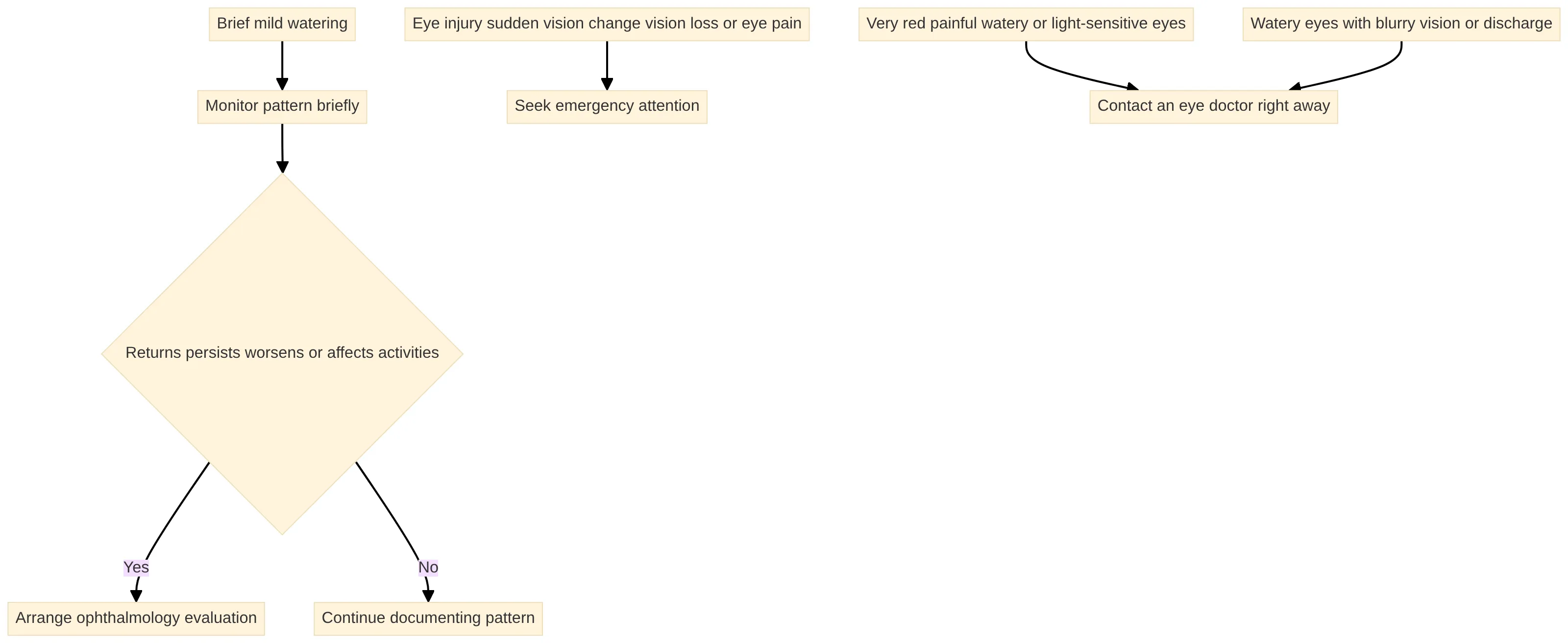
- Monitor briefly: If watering is mild, passes, and is not accompanied by warning signs, record when it happens and what seems to bring it on. Move to an eye-care evaluation if it persists, returns, worsens, or begins to interfere with daily activities.
- Arrange an ophthalmology evaluation: Persistent or recurring watering deserves discussion with an eye doctor, especially when lubricating drops have not improved associated dry-eye symptoms or when the symptom affects normal activities.
- Seek prompt or emergency attention: Do not wait for a routine visit if you have an eye injury, sudden vision change or vision loss, or eye pain. These features can require emergency attention.
This guide helps you choose a next step. It cannot identify the cause of your symptoms from home.
Understand the two main pathways behind watery eyes
Watery eyes generally follow one of two broad pathways: the eyes produce more tears than usual, or tears do not drain normally. The distinction matters because watering alone does not show which pathway is involved. A clinical history and examination may be needed when the pattern is persistent, severe, or difficult to interpret.
Excess tear production can occur when the eye surface is irritated. Dry eye is one example: the surface may feel gritty or as though something is present, and watering may become more noticeable in cold or windy weather, smoke, or dry heat. Other surface problems can create a similar response. Blocked or inadequate tear drainage is a separate pathway, and symptoms alone may not show whether drainage is contributing.
The two pathways can also look similar in everyday life. You may notice tears collecting or running down your cheek without knowing whether the eye is reacting to irritation or failing to clear tears normally. That is why the duration, setting, one-eye or both-eye pattern, and accompanying symptoms matter more than the amount of tearing by itself.
Surface irritation associated with conjunctivitis, eyelid inflammation, an inward-turning eyelid or eyelash, a corneal scratch, or a foreign body is among the recognized causes of watering. That list is a set of possibilities, not a checklist you can use to diagnose yourself.
The practical consequence is simple: do not assume that visible tears mean your eyes are adequately lubricated, and do not assume that watering proves a drainage blockage. A pattern that changes with wind, smoke, dry heat, or the end of the day may fit surface irritation, but an examination is still what separates a possible pattern from a confirmed explanation. If watering continues or keeps returning, arrange an eye-care assessment rather than repeatedly changing self-care based on the symptom alone.
If the symptom began after an injury or with a sensation that something is stuck in your eye, treat that history as relevant rather than folding it into ordinary irritation. Pain, blurred vision, or a foreign-body sensation alongside watering warrants prompt attention.
Look for dry-eye and surface-irritation patterns
Dry eye can include watering, even though the symptom may seem opposite to dryness. A possible pattern is watering that becomes worse in cold or windy conditions, around cigarette smoke, or in dry heat. You may also notice an intermittent gritty or foreign-body sensation, particularly toward the end of the day. Those observations can give an ophthalmologist useful context, but they do not establish that dry eye is the cause in your case.
Write down the setting rather than assigning a label. For example, record whether the symptom appears outdoors in wind, after time in dry air, late in the workday, or alongside a gritty sensation. Also note whether it affects one eye or both. A short, specific record is more useful than a conclusion such as “my eyes are dry,” because several conditions can produce overlapping symptoms.
A pattern that follows a particular environment may be worth discussing even when the eyes look normal between episodes. The absence of constant watering does not settle the cause, and temporary relief does not confirm that you have identified it.
Surface irritation can also occur with conjunctivitis, eyelid inflammation, a scratch, or a foreign body. Conjunctivitis has different possible forms. Viral conjunctivitis often causes watery discharge and may occur during or after a cold or upper-respiratory infection. Allergic conjunctivitis usually involves intense itching, increased tearing, and both eyes. An ophthalmologist can usually assess whether conjunctivitis is viral, bacterial, or allergic by reviewing the symptoms and examining the eyes, including redness and discharge.
Do not use one feature to settle the question. Itching can point toward an allergic pattern, while watery discharge can occur with a viral pattern, but overlapping symptoms and other eye conditions still matter. Pain, blurred vision, marked redness, light sensitivity, or discharge changes the urgency and should move you away from casual monitoring.
If discharge is present, describe its appearance and when it occurs rather than assuming that it identifies the cause. The combination of discharge, redness, pain, and vision changes gives an eye doctor more useful information than the word “watery” alone.
Use timing, triggers, and associated symptoms to sort your next step
Timing and associated symptoms give you a practical way to organize what happens before you arrange care. For each episode, note:
- when the watering began and how long it lasted;
- whether one eye or both eyes were affected;
- whether cold, wind, smoke, dry heat, screen work, contact-lens wear, or a recent cold occurred around the same time;
- whether you noticed grittiness, itching, redness, pain, light sensitivity, discharge, blurred vision, or another change in vision; and
- whether the symptom is becoming more frequent, lasting longer, or affecting daily activities.
This record does not diagnose the problem. It gives the eye-care professional a clearer account of chronicity and severity when excess tear production and drainage problems can be difficult to distinguish.
Include what happens between episodes. Note whether your eyes feel normal, gritty, itchy, red, or blurry afterward, and whether the watering stops when you leave a particular setting. These details help keep the conversation focused on the pattern rather than on a single moment.
Use the record to choose the next level of attention:
- A brief episode without warning signs: Monitor the pattern for a short period and document what you notice. If it returns or does not settle, arrange an evaluation.
- A recurring, persistent, worsening, or activity-limiting pattern: Contact an eye doctor. The American Academy of Ophthalmology advises evaluation for dry-eye symptoms that persist, worsen, affect daily activities, or occur with significant redness, pain, or vision changes.
- A sudden or painful change: Do not use monitoring as the plan. Eye injuries, sudden changes to or loss of vision, and eye pain can require emergency attention.
The boundary is the associated symptom, not just the number of tears. A symptom that seems minor in isolation deserves faster attention when it arrives with pain, vision changes, significant redness, light sensitivity, or discharge.
If you are unsure which branch fits because the pattern is changing, choose an eye-care assessment rather than extending observation indefinitely. A changing pattern is itself useful information to report.
Arrange an ophthalmology evaluation when watering persists or returns
Persistent or recurrent watering is a reason to arrange an ophthalmology evaluation, even when the symptom is not severe at every moment. Dry-eye symptoms warrant an eye doctor’s input when they persist, worsen, affect daily activities, do not improve with lubricating drops, or occur with significant redness, pain, or vision changes. More generally, distinguishing excess tear production from inadequate drainage can be difficult without evaluation.
That does not mean persistent watering points to one specific condition. It means the symptom has become consistent enough to deserve a closer look.
Recurrent symptoms also deserve attention when they interrupt work, reading, driving, outdoor activities, or contact-lens wear. You do not need to wait until watering happens continuously to discuss a pattern that keeps returning.
Bring your observation record to the appointment. Include the start date, episode pattern, triggers, contact-lens use if relevant, recent illness or injury, and any change in vision. Describe what the symptom feels like as well as what it looks like: gritty, itchy, painful, light-sensitive, blurry, or associated with discharge are different details.
A brief vision screening is not the same as a comprehensive eye examination. MedlinePlus explains that screening mainly checks how well you see up close and far away, while a comprehensive dilated eye exam evaluates more. If a scratch or foreign body is suspected and the diagnosis is unclear or vision loss is present, evaluation can include a history, physical examination, and ophthalmic examination. Give the clinician enough detail to decide which parts of an eye assessment are appropriate.
Write down questions before the visit if the symptom has been difficult to describe. You might ask what the pattern suggests, whether both tear production and drainage need consideration, and what changes should prompt faster follow-up. The aim is to turn repeated observation into a useful clinical history.
Recognize warning signs that should not wait
Some combinations of symptoms should move you out of the monitoring lane. A painful, watering eye with blurred vision or a foreign-body sensation can be associated with an object on or a scratch to the eye’s surface.
These signs do not tell you exactly what is happening. They tell you that the cost of waiting for the symptom to explain itself may be too high. If a sudden event, injury, pain, or vision change is present, use urgent medical guidance rather than trying another home measure first.
A foreign-body sensation matters even when you cannot see anything in the eye. Likewise, blurred vision matters even if watering is the symptom that first caught your attention. Describe the entire combination when you seek care.
The American Academy of Ophthalmology advises contacting an eye doctor right away if your eyes are very red, painful, watery, or light-sensitive, or if you have blurry vision or discharge. Those features can accompany serious eye problems. The same source advises discussing any eye or vision symptoms with an ophthalmologist rather than relying on an online symptom list to diagnose a condition.
Do not wait for watering to become constant before acting on a warning sign. Do not let the absence of pain reassure you if you have sudden vision loss or a significant eye injury. When several signs occur together, describe them together when you seek care: “watery and painful,” “watery with blurred vision,” or “watery with discharge” conveys more useful information than “my eye is tearing.”
If you wear contact lenses and develop pain, redness, blurred vision, or light sensitivity, mention the lens use immediately when arranging care. That history can affect how the symptom is assessed.
Keep supportive measures limited while you arrange care
While you arrange care, keep your actions focused on observation and on avoiding the settings that clearly aggravate the symptom. If watering appears during cold, wind, smoke, or dry heat, record that trigger and reduce exposure where practical. Note whether the symptom settles when the exposure ends, then keep watching for recurrence. This information can help clarify whether surface irritation may be part of the pattern without proving that it is.
A symptom log is the most useful immediate aid. Keep it short:
- date and approximate duration;
- one eye or both;
- setting or trigger;
- gritty, itchy, red, painful, light-sensitive, blurry, or discharge-related symptoms; and
- effect on work, driving, reading, or other daily activities.
Use the log to support a consultation, not to postpone one. If the pattern changes while you are tracking it, update the record rather than relying on your first description.
Do not keep changing over-the-counter lubricating drops as a substitute for evaluation when symptoms persist, worsen, affect daily activities, or fail to improve with them. Significant redness, pain, or vision changes also call for an eye doctor’s assessment. Likewise, do not use improvement after a temporary measure as proof that you have identified the cause.
You can document the symptom, avoid a clear environmental trigger, and arrange care. You should not use this general guide to choose prescription treatment, decide that an infection is present, or determine whether a procedure is appropriate. If a warning sign appears, leave the monitoring plan and seek prompt attention.
Supportive observation has a clear limit: it is appropriate only while the symptom remains mild and free of warning signs. Persistence, recurrence, worsening, or interference with daily activities moves the situation into the evaluation lane.
Know what an eye-care evaluation may clarify
An eye-care evaluation can clarify questions that symptom tracking cannot answer. The purpose is not simply to measure how well you can read a chart. A comprehensive dilated eye exam evaluates more than a brief vision screening, which mainly checks near and distance vision.
Bring the full pattern to the appointment rather than presenting only the most recent episode. Mention whether watering is intermittent or constant, whether it returns in particular environments, and whether you have gritty sensations, itching, redness, pain, light sensitivity, discharge, or blurred vision. Persistent symptoms can have more than one relevant feature, and the examination helps determine which details need attention.
The evaluation is also a chance to explain what you have already tried and whether it changed the symptom. Report the timing and effect of lubricating drops without assuming that either improvement or lack of improvement settles the cause.
The evaluation may also clarify whether the symptom pattern fits a surface problem that needs different consideration. An ophthalmologist can usually assess whether conjunctivitis is viral, bacterial, or allergic by reviewing symptoms and examining redness and discharge. When a corneal abrasion or foreign body is suspected and the diagnosis is unclear or vision loss is present, assessment can include a history, physical examination, and ophthalmic examination.
That is why a label based only on appearance can mislead you. “Watery,” “red,” and “irritated” describe what you notice; they do not by themselves identify the underlying issue. Give the clinician the observations, the timing, and the warning signs, then let the examination determine what they mean.
An evaluation can therefore answer a more useful question than “Why are my eyes watering?” It can help identify which part of the pattern requires attention and whether the appropriate next step is continued follow-up or a different form of care.
Do not assume screens or contact lenses explain every case
Screen use may belong in the history, but it should not end the investigation. We recognize that prolonged use of computer screens, television, and smartphones can cause dry eye and fatigue. Dry eye can include watering, especially in conditions such as wind, smoke, or dry heat. That makes screen-related dryness a possible part of some patterns, not a universal explanation for every episode of tearing.
Record the timing precisely. Does watering appear during screen work, toward the end of the day, or after you leave a screen? Does it continue away from the screen? Are there gritty sensations, fluctuating blur, redness, pain, or light sensitivity? These distinctions give an ophthalmologist something more useful than a broad assumption that “screens caused it.” If the symptom persists or affects daily activities, arrange an evaluation.
A screen-related pattern may overlap with other causes of surface irritation. Keep the screen detail in your history, but keep the rest of the symptom record with it. Timing alone cannot confirm dry eye or rule out another explanation.
Contact-lens wear also belongs in the history without becoming a diagnosis. We recognize that contact lenses can irritate, dry out, and worsen allergies. The symptom combination matters more than the fact that you wear lenses.
Tell the eye-care professional how watering relates to lens wear and how long the episodes last. If watering persists or recurs, arrange an evaluation rather than assuming lens discomfort is routine. Contact-lens use may be relevant, but it does not explain every watery-eye pattern.
Record whether the symptom begins while lenses are in place, after you remove them, or on days when you do not wear them. That comparison can make your history more precise, but it cannot replace an examination when symptoms persist or warning signs appear.
Match your symptom pattern to the next level of care
| Your observable pattern | What it may mean for timing | Direct next action |
|---|---|---|
| Brief, mild watering with no pain, injury, sudden vision change, vision loss, marked redness, light sensitivity, blur, or discharge | A short period of observation may be reasonable while you record timing and triggers | Monitor the pattern briefly, then arrange an eye-care evaluation if it returns, persists, worsens, or affects daily activities |
| Persistent or recurrent watering, worsening symptoms, activity interference, or associated dry-eye symptoms that do not improve with lubricating drops | The pattern deserves professional assessment rather than repeated self-treatment | Arrange an ophthalmology evaluation and bring your symptom record |
| Eye injury, sudden vision change or vision loss, or eye pain | The symptom may require emergency attention | Seek emergency attention rather than waiting for a routine appointment |
| Very red, painful, watery, or light-sensitive eyes, or watery eyes with blurry vision or discharge | The American Academy of Ophthalmology advises contacting an eye doctor right away | Contact an eye doctor right away and describe every associated symptom |
The table is a timing guide, not a diagnosis chart. If your symptoms fit more than one row, follow the row with the faster action. For example, recurring watering may belong in the evaluation lane, but recurring watering with pain or a sudden change in vision belongs in the urgent lane.
If you cannot tell whether a symptom is mild, persistent, or significant, choose assessment rather than extending observation indefinitely. Excess tear production and inadequate drainage can be difficult to distinguish, and symptom lists cannot cover every eye or vision problem. Your job is to communicate the pattern and act on warning signs, not to identify the condition before seeking care.
Recheck the pattern whenever something changes. A new injury, sudden vision change, pain, marked redness, light sensitivity, blurred vision, or discharge takes priority over the earlier plan to monitor. The next step is determined by the most concerning associated symptom, not by the fact that watering may have started mildly.
Choose a local eye-care consultation in Westlake Village
Watery eyes do not have one automatic explanation. The symptom may reflect excess tear production, impaired drainage, or surface irritation such as dry eye, and the pattern alone may not separate those possibilities. Monitor briefly only when the episode is mild and free of warning signs. Arrange an ophthalmology evaluation when watering persists, returns, worsens, or affects daily activities. Seek prompt or emergency attention for injury, sudden vision change or vision loss, eye pain, marked redness, light sensitivity, blurred vision, or discharge.
An ophthalmologist or other qualified eye-care professional must decide what individual evaluation and care are appropriate. You can make that visit more useful by bringing a concise record of timing, triggers, one-eye or both-eye involvement, and associated symptoms.
The practical decision is simple: observe briefly only when the pattern is mild and settles, arrange an evaluation when it persists or returns, and act promptly when warning signs appear.
We provide medical eye care, including dry-eye treatment, at our Westlake Village office. We also offer comprehensive eye examinations and advanced services. If your watering is persistent, recurrent, or concerning and you cannot determine the cause from symptoms alone, an ophthalmology consultation is an appropriate next step.
Frequently Asked Questions About Watery Eyes
What are common causes of watery eyes?
Watery eyes can result from increased tear production or inadequate drainage. Common causes include dry eye, surface irritation from conditions like conjunctivitis, eyelid inflammation, or foreign bodies in the eye.
When should I seek an ophthalmology evaluation for watery eyes?
You should arrange an ophthalmology evaluation if your watery eyes are persistent, recurrent, worsening, or affecting your daily activities, especially if they do not improve with over-the-counter lubricating drops.
What symptoms indicate that I need urgent eye care?
Seek urgent care if you experience eye pain, sudden changes in vision, vision loss, very red eyes, marked light sensitivity, or discharge, as these can signal serious eye problems.
How can I track my symptoms before seeing an eye doctor?
Keep a record of when the watering occurs, how long it lasts, whether it affects one or both eyes, any triggers like cold or wind, and any associated symptoms such as pain or redness.
Can screen use cause watery eyes?
Prolonged use of screens can contribute to dry eye symptoms, which may include watering. However, it should not be assumed to be the sole cause of watery eyes.
What supportive measures can I take while arranging care for watery eyes?
While arranging care, you can monitor your symptoms, avoid known irritants, and document your experiences, but do not rely solely on over-the-counter drops if symptoms persist.