Start with the decision watery eyes require
Watery eyes are a symptom, not a diagnosis. Excess tears can appear alongside irritation, dryness, contact-lens discomfort, redness, blurred vision, or other changes, so the useful first question is not “What condition do I have?” but “What should I do next?” General symptom information cannot diagnose a specific eye disease or condition.
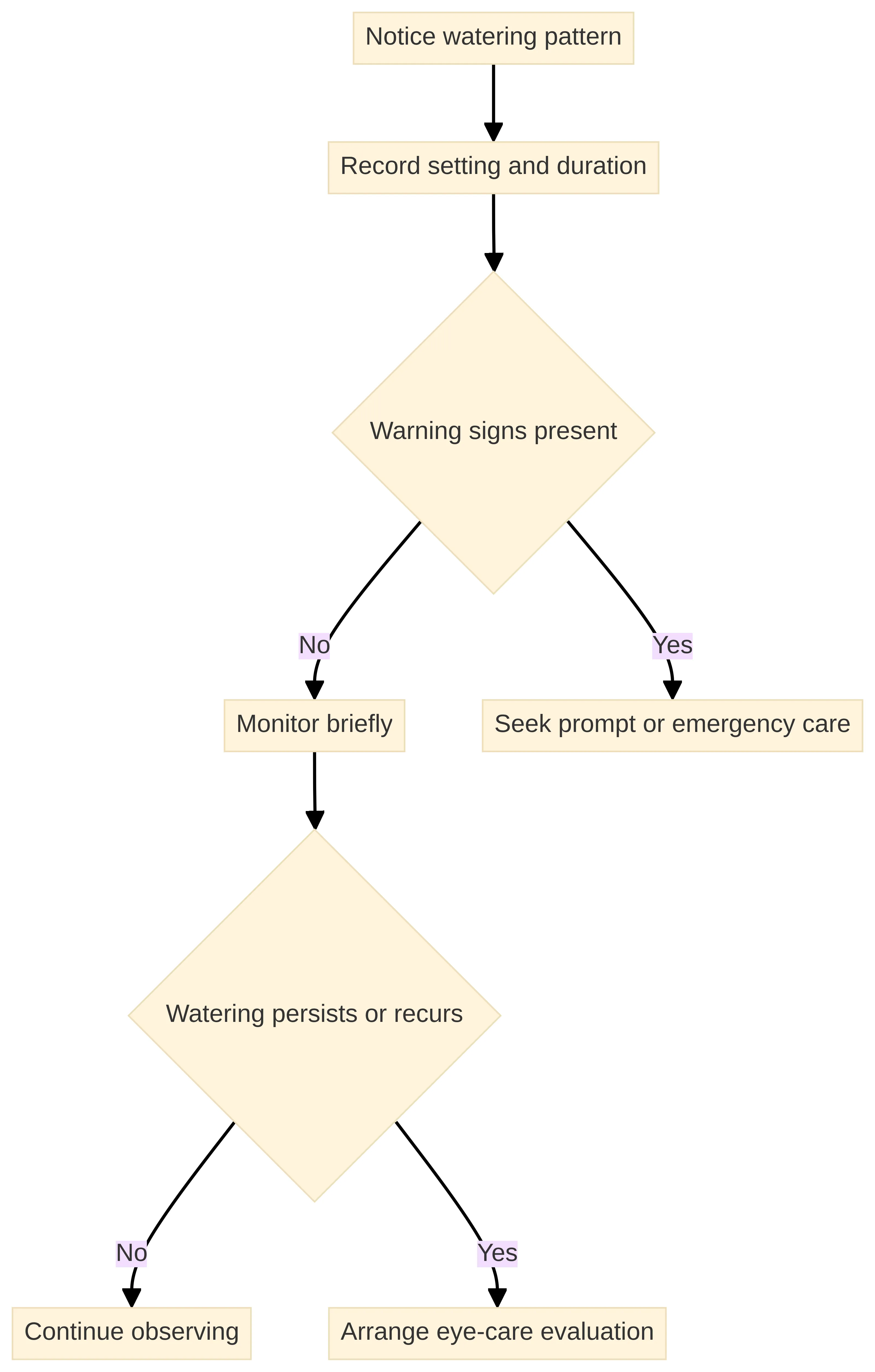
A practical decision has three paths:
- Monitor a mild, occasional pattern: Notice when watering happens, what accompanies it, and whether a clear environmental or activity-related trigger is present.
- Arrange an eye evaluation: Choose this path when watering persists, returns repeatedly, interferes with contact-lens use, or comes with symptoms that you cannot explain from a brief pattern alone.
- Seek prompt eye-doctor contact: Contact an eye doctor promptly when watering appears with marked redness, pain, light sensitivity, blurry vision, or discharge. Sudden vision changes or vision loss, an eye injury, or eye pain can require emergency attention.
The sections below help you sort your symptoms without assigning yourself a diagnosis.
Your symptom pattern matters more than the word “watering” by itself. Cold or windy air, cigarette smoke, and dry heat can make watering associated with dry eye more noticeable. A gritty sensation, burning, blurred vision while reading, redness, mucus, or discomfort with contact lenses can add useful context. Very red or painful eyes, light sensitivity, blurry vision, or discharge change the urgency of the next step.
Use this guide as a sorting tool. Do not use it to decide that screen use, dry eye, allergies, infection, or any other single explanation is definitely responsible for your symptoms.
Start by asking three practical questions: Is the pattern mild and occasional? Does it keep returning or interfere with normal activities? Are pain, vision changes, marked redness, light sensitivity, discharge, or injury present? Your answers can help you choose between observation, a routine evaluation, and prompt care without requiring you to name the cause.
Understand why dry eyes can cause excess tearing
Dry eyes can sometimes cause watering, particularly in cold, windy, smoky, or dry conditions, and may feel like something is in the eye. The surface can feel dry or irritated while the eyes produce noticeable tears, so visible tearing does not automatically rule out dry-eye symptoms.
Dry-eye symptoms can include burning, blurred vision while reading, grittiness, mucus, redness, contact-lens discomfort, and lots of tears. You may notice several of these together, or you may notice watering as the most obvious feature. The combination can suggest that dryness belongs in the conversation, but it cannot establish the cause of your symptoms.
A dry or gritty sensation is therefore useful information, not a final answer. Note whether the feeling comes and goes, whether it is stronger later in the day, and whether watering appears with it. Then use that pattern to decide what level of follow-up makes sense.
Computer work may contribute to dry-eye symptoms, in part because you may blink less often while concentrating. DLV Vision’s own guidance also describes prolonged use of computers, televisions, and smartphones as a contributor to dry eye and fatigue. That connection is a possible contributor, not a diagnosis for every episode of watering.
Pay attention to timing. If watering, grittiness, fatigue, or fluctuating clarity appears during or after long periods of screen work, record that pattern. If watering occurs just as often away from screens, that observation points you toward a broader evaluation rather than a single screen-related explanation. Either way, keep the conclusion modest: your pattern can guide the next question, but an examination is needed to determine what is happening.
A screen-related pattern can also overlap with contact-lens discomfort, outdoor exposure, or another source of irritation. Treat the timing as one piece of information. Do not let it settle the diagnosis by itself.
Separate common contributors without choosing a diagnosis
Watery eyes can have several possible contributors, and overlapping symptoms make self-diagnosis unreliable. Irritation of the eye surface can be associated with conditions such as conjunctivitis from allergies, chemicals, or infection; blepharitis; an eyelid or eyelash problem; a corneal scratch; or a foreign body. Dry-eye symptoms can also have many possible contributors, including aging, contact lenses, some medicines, certain medical conditions, and dry or windy environments.
These categories are useful because they tell you what to observe, not because they let you select a condition. For example, watering after exposure to wind may fit a dry-eye pattern, while a gritty sensation may occur with surface irritation. Neither observation proves the explanation. Treat each pattern as a reason to decide whether monitoring is reasonable or an examination would be more useful.
The practical distinction is between a possible contributor and a confirmed cause. A possible contributor helps you describe what was happening before the symptom began. A confirmed cause requires an appropriate eye examination and clinical judgment.
Contact lenses deserve their own place in your notes. Contact lenses can irritate and dry out the eyes and may worsen allergies. Contact-lens-related blurry or fluctuating vision may be worse at the end of the day as the eyes become dry and tired. The American Academy of Ophthalmology also lists painful contact-lens wear among symptoms associated with dry eye.
Record whether watering begins during lens wear, after several hours, or on days when you use glasses instead. Note discomfort, fluctuating vision, redness, or a gritty feeling at the same time. Do not treat a lens-related pattern as proof that the lenses are the only cause; use it as information to bring to an eye-care evaluation, particularly if lens wear is becoming harder to tolerate.
Contact-lens timing can be especially useful when the symptom changes during the day. Write down when your eyes first feel uncomfortable and whether the watering continues after lens use ends. That detail gives an eye-care professional a clearer starting point.
A symptom list cannot tell you which category applies. Watery eyes may reflect surface irritation, dryness, or another eye problem, and online symptom information is for general reference rather than diagnosis. The practical boundary is simple: use patterns to choose your next step, not to label the condition yourself.
Avoid forcing every symptom into the same explanation. Watering that follows wind may differ from watering with pain or discharge, and a pattern that occurs with contact-lens discomfort may require different questions from one that appears only outdoors. When the pattern is unclear, an evaluation is more useful than continued guesswork.
Use the symptom pattern to choose whether to monitor or evaluate
Monitoring can be reasonable when watering is mild, occasional, and linked to a pattern you can observe, such as cold air, wind, smoke, dry heat, or concentrated computer work. Monitoring does not mean ignoring the symptom. It means recording the setting, duration, associated sensations, and whether the pattern changes.
Choose monitoring as a short observation period only when you have no warning signs. If the watering keeps returning, becomes more disruptive, or develops new symptoms, move from observation to an eye-care evaluation.
A useful monitoring record answers four questions: what were you doing, what did your eyes feel like, how long did the episode last, and what happened afterward? Write down the answer while the details are easy to recall. Bring the record forward if monitoring does not settle the pattern.
Un eye evaluation makes more sense when watering persists or recurs, when the pattern has no clear trigger, or when it occurs with grittiness, burning, blurred reading vision, redness, mucus, or contact-lens discomfort. The American Academy of Ophthalmology advises talking with an ophthalmologist about eye or vision symptoms, while dry-eye guidance identifies several symptom combinations that deserve attention.
Arrange an evaluation when the symptom is becoming part of your routine rather than a brief response to a particular setting. Bring your observations so the appointment can start with a concrete pattern instead of a vague description.
You can also choose an evaluation when the symptom is difficult to interpret even if it is not severe. Repeated uncertainty is itself a reason to stop relying on symptom matching. The purpose of the visit is to clarify what should be monitored, what may be contributing, and what follow-up is appropriate.
Prompt care belongs ahead of routine monitoring when watery eyes are accompanied by marked redness, pain, light sensitivity, blurry vision, or discharge. Sudden changes to or loss of vision, an eye injury, or eye pain can require emergency attention. Use the urgency of the accompanying symptom—not the amount of tearing alone—to decide how quickly to seek help.
Do not wait for a pattern to repeat before acting on these warning signs. A new change in vision, significant pain, or an injury deserves attention based on the event itself.
Try low-risk steps while observing the pattern
Observation is more useful when you make it specific. For several episodes, write down:
- When the watering started and how long it lasted.
- Whether you were working at a computer, outside in wind or dry heat, near smoke, or wearing contact lenses.
- Whether you noticed grittiness, burning, redness, mucus, blurred reading vision, or fluctuating clarity.
- Whether one eye or both eyes were affected.
- Whether the pattern appeared at a particular time of day or after a repeated activity.
- Whether the symptom eased when the activity or environmental exposure ended.
This record is a practical aid for describing your symptoms. It does not diagnose the cause or establish that one trigger is responsible.
Environmental and activity patterns can give you low-risk observations to test. Note whether watering is worse in cold or windy weather, cigarette smoke, or dry heat. During computer work, notice whether concentrated periods coincide with less blinking, dryness, fatigue, or watering. If a setting repeatedly worsens your symptoms, reduce exposure where practical while you arrange the next step.
Avoid turning this observation into a guarantee. A change in setting may alter the symptom without explaining why it occurs.
You can make the observation more consistent by recording similar details each time. Compare a workday with a non-workday, indoor time with outdoor time, or contact-lens wear with glasses use when those situations naturally occur. The purpose is to describe differences, not to conduct a test that proves a diagnosis.
For mild or moderate dry-eye symptoms, a clinical self-care leaflet lists a warm compress as one practical measure and says it can loosen oil produced by glands. If you choose to try that measure, keep the purpose narrow: it is a self-care option listed for mild or moderate symptoms, not a way to confirm dry eye or replace an evaluation.
Contact-lens discomfort, marked redness, pain, light sensitivity, blurry vision, discharge, sudden vision change, vision loss, or injury should move you out of self-monitoring and toward prompt or emergency care.
Use self-care as a limited observation step, not as a reason to continue indefinitely. If the symptom persists, recurs, or changes, take the record to an eye-care professional instead of adding more measures on your own.
Know when recurring watering deserves an eye examination
Recurring watering deserves an eye examination when it continues to return, affects your daily activities, or appears with other eye or vision symptoms. The American Academy of Ophthalmology advises discussing eye or vision symptoms with an ophthalmologist, and its dry-eye guidance includes watering among symptoms that can occur with dry eye.
You do not need to wait until the symptom becomes severe to organize a routine evaluation. Persistent or repeated episodes are enough to make a professional assessment a sensible next step, especially when you cannot identify a consistent trigger or when contact lenses are becoming uncomfortable.
A recurring pattern is worth discussing even when each individual episode seems brief. Frequency, timing, and associated symptoms can matter together, and an examination can address questions that a single episode cannot answer.
Your symptom record can make a recurring-watering appointment more focused. Bring the timing of episodes, screen exposure, outdoor conditions, contact-lens use, and associated changes such as grittiness, burning, mucus, redness, or fluctuating vision. Mention medicines or medical conditions that may be relevant to dry-eye symptoms, because clinical guidance identifies some medicines and certain medical conditions as possible contributors.
The goal is not to arrive with a diagnosis. The goal is to describe the pattern clearly enough for the evaluation to address the right questions.
Also note whether the symptom is affecting reading, computer work, driving, outdoor time, or contact-lens wear. These practical effects help explain why the symptom matters to you without requiring you to decide what caused it.
Choose prompt care rather than a routine appointment if recurring watering changes into very red, painful, light-sensitive, blurry, or discharging eyes. Choose emergency attention for sudden vision changes or vision loss, an eye injury, or eye pain. Those features change the decision because they can signal a serious eye problem.
If none of those warning signs is present but the watering keeps returning, arrange a routine eye evaluation and bring your symptom record. If a warning sign appears while you are waiting, change course and seek prompt care.
Do not wait with pain, vision change, or marked inflammation
When you seek prompt or emergency care, describe the change plainly: when it began, whether vision changed suddenly, whether pain or light sensitivity is present, whether the eye is very red, and whether discharge appeared. Mention an injury even if the watering seems like the main problem. Clear timing and accompanying symptoms help communicate why you are seeking care.
If both eyes are affected, say so. If only one eye changed, include that detail as well. Your job is to report the pattern and the change; a qualified eye-care professional determines what it means.
What a professional evaluation may clarify
An eye examination may examine more than the presence of tears. Depending on your symptoms, it may include vision testing, refraction, a slit-lamp examination, tear-film assessment, and other tests of tear production or corneal function. The specific testing depends on the clinical questions raised by your symptoms and examination.
These steps can help organize the difference between a surface-irritation pattern, a dry-eye pattern, a contact-lens concern, or another issue. Your symptom history still matters because timing, triggers, and accompanying changes give the examination useful context.
An evaluation is not a promise that one test will explain every episode. It is a structured way to examine the eye and decide what information or follow-up is appropriate for your pattern.
The possible components of an evaluation can include:
- Vision testing and refraction: checks related to how clearly you see and how your prescription may be measured.
- Slit-lamp examination: allows close examination of the visible eye structures.
- Tear-film assessment: may include tear-breakup time or other assessment of tear quality.
- Testing of tear production or corneal function: may be considered when the symptoms call for it.
The list is not a promise that every test will be used. It is a way to understand why an examination can answer questions that symptom matching cannot.
The symptoms you report help determine which questions deserve attention. Mention screen timing, outdoor exposure, contact-lens use, end-of-day changes, and any warning signs rather than focusing only on the amount of tearing.
Bring focused questions to the appointment: Does the timing suggest a surface-irritation or dry-eye concern? Could contact-lens wear be contributing to the pattern? Which associated symptoms should change the urgency of follow-up? What should you record if watering continues?
Keep the conversation tied to your actual pattern. A recurring symptom with contact-lens discomfort, end-of-day fluctuating vision, or screen-related fatigue gives the clinician more useful information than a conclusion that you have already chosen a condition.
You can also ask what changes should prompt earlier follow-up and what information would be useful to record between visits. Those questions keep the next step practical without asking you to diagnose yourself.
A local next step in Westlake Village
DLV Vision provides vision correction and medical eye care, including dry-eye treatment, at our Westlake Village office. If your watery eyes persist or recur, a local eye-care consultation can give you a place to discuss the pattern, associated symptoms, contact-lens comfort, and whether an evaluation fits your situation.
Bring the observations you recorded: timing, screen or outdoor exposure, lens use, and any redness, grittiness, burning, blurred vision, mucus, pain, or light sensitivity. A qualified eye-care professional decides what evaluation or treatment is appropriate for your individual situation. If your symptoms include sudden vision change, vision loss, an eye injury, or eye pain, use emergency care rather than waiting for a routine consultation.
For persistent or recurring watering in Los Angeles and Ventura County, a Westlake Village consultation can turn your symptom pattern into a clear next-step discussion. Use prompt or emergency care instead when warning signs make waiting inappropriate.
Questions to consider before seeking care for watery eyes
What are common causes of watery eyes?
Watery eyes can result from various factors, including dry eyes, irritation from environmental conditions like wind or smoke, allergies, infections, and issues with eyelids or eyelashes. Each cause may present with different accompanying symptoms.
When should I seek professional evaluation for watery eyes?
Consider scheduling an eye evaluation if your watery eyes persist, return frequently, interfere with daily activities, or are accompanied by symptoms like pain, redness, light sensitivity, or blurry vision.
How can I prepare for an eye examination regarding watery eyes?
Bring a record of your symptoms, including when they occur, any associated activities or environmental factors, and details about contact lens use. This information can help the eye care professional assess your situation more effectively.